The Account He Hid for 36 Years
I balanced our family checkbook every month for thirty-six years.
Not because my husband asked me to.
Because I believed that was what married people did.
Every paycheck, every grocery bill, every mortgage payment, every utility bill—I wrote it down. I kept receipts in labeled envelopes and reconciled our bank statements down to the last cent.
In thirty-six years, I never missed a single transaction.
Until one Tuesday morning.
I was sitting at the kitchen table with a cup of coffee when I noticed something strange.
$800.00 — AUTOMATIC TRANSFER — 15TH OF MONTH.
I stared at the line.
I didn’t recognize the account.
I checked the previous month’s statement.
There it was.
And the month before that.
And the month before that.
My hands went cold.
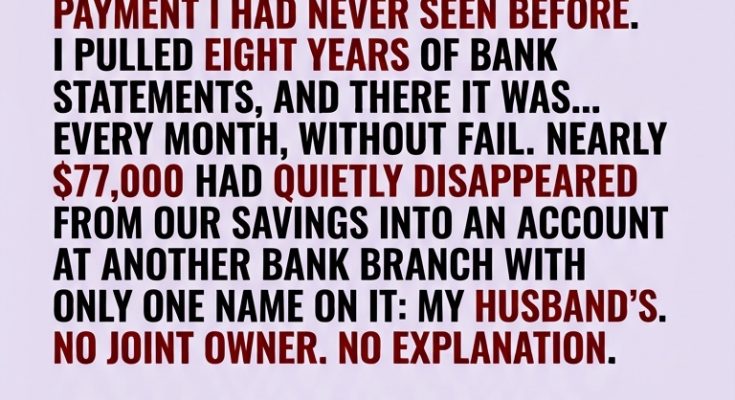
I pulled out eight years of old bank statements and began searching.
One by one.
Month after month.
Year after year.
The same $800 transfer appeared on the fifteenth.
Every single month.
For eight years.
That was $76,800.
Nearly seventy-seven thousand dollars had quietly disappeared from our savings.
I confronted my husband that evening.
“What’s the $800 transfer?”
He froze.
Only for a second.
Then he shrugged.
“Probably some old automatic payment.”
“To where?”
“I don’t know.”
That answer frightened me more than an explanation would have.
“You don’t know?”
He stood up.
“I’m tired, Linda. We’ll talk about it later.”
But I wasn’t tired.
I was awake in a way I hadn’t been in years.
The next morning, I went to the bank.
I brought our marriage certificate, identification, and eight years of statements.
The manager listened quietly as I explained what I’d found.
She typed something into her computer.
Then she frowned.
“There’s another account connected to the transfer.”
“My name isn’t on it?”
She hesitated.
“No.”
“Whose name is on it?”
She looked at me carefully.
“Your husband’s.”
My stomach dropped.
“Can you tell me the balance?”
She paused.
Then slowly turned the computer screen toward me.
I looked.
And forgot how to breathe.
The account balance was:
$412,684.17
I stared at the number.
Four hundred twelve thousand dollars.
This wasn’t an account holding the $800 transfers.
It was an account that had been growing for decades.
The manager explained that the account itself was much older than the eight-year transfer history I had access to.
There were investment deposits.
Interest.
Certificates of deposit.
Occasional large transfers.
And one beneficiary listed on the account.
Not me.
A woman named Margaret Collins.
My husband’s mother.
I left the bank shaking.
My mother-in-law had died eleven years earlier.
That night, I placed the bank documents on the kitchen table.
My husband came home.
He saw the papers.
His face changed.
“You went to the bank.”
“Yes.”
He sat down.
For several seconds, neither of us spoke.
Finally, he whispered, “I was going to tell you.”
“When?”
He looked down.
“I don’t know.”
“How long?”
He swallowed.
“The account started when my father died.”
“How much was there originally?”
“About twenty thousand.”
“And the $800?”
He rubbed his forehead.
“I transferred money every month because I wanted to build something.”
“For yourself?”
He didn’t answer.
That silence told me everything.
I pushed the papers toward him.
“Why didn’t you tell your wife?”
He finally looked at me.
“Because I knew you’d use it for the family.”
I felt something inside me crack.
“Of course I would.”
“Our daughter needed help with college. Our son needed money for his business. We had medical bills. We had a mortgage.”
“I know.”
“Then why hide it?”
His eyes filled with tears.
“Because I was scared.”
“Of what?”
“Of getting old with nothing that belonged only to me.”
I stared at him.
After thirty-six years of marriage, my husband had been secretly preparing for a future in which he apparently expected to stand alone.
But then I noticed something else.
“Who’s the beneficiary now?”
He didn’t answer.
I already knew.
Margaret Collins.
His dead mother.
I pushed the document toward him.
“You never changed it.”
He looked at the paper.
Then he closed his eyes.
“I forgot.”
That was when I understood something painful.
The money wasn’t the real betrayal.
The real betrayal was that my husband had spent years building a private escape route while I believed we were building one life together.
I didn’t scream.
I didn’t threaten divorce.
I simply stood up.
“I’m not angry because you saved money.”
He looked at me.
“I’m angry because you made a decision about our marriage without giving me a voice in it.”
He cried.
For the first time in thirty-six years, I saw my husband genuinely afraid of losing me.
We spent the next several weeks going through everything.
The account.
The investments.
Our retirement plans.
Our debts.
Our wills.
Our beneficiaries.
Everything.
And eventually, he told me the whole story.
His father had died suddenly when he was young. Before his death, he had warned my husband:
“Always keep something for yourself. Life can change overnight.”
My husband had taken those words literally.
He’d opened the account quietly.
At first, there was only a little money.
Then, after we paid off our mortgage, he began transferring $800 every month.
He told himself it wasn’t hurting anyone.
But the secret grew.
So did the balance.
And eventually, the secret became more important than the money.
We went to a financial adviser together.
We changed the beneficiary.
We created a joint retirement account.
And we agreed that every major financial decision from that day forward would be made together.
But I made one condition.
The $412,684 wouldn’t simply disappear into our regular spending.
We divided it carefully.
Some went toward our retirement.
Some went into an emergency fund.
And a portion went into separate personal accounts for both of us.
Not because I wanted revenge.
Because I finally understood what my husband had been trying—and failing—to teach himself all those years.
Marriage doesn’t mean you aren’t allowed to have something of your own.
It means you don’t secretly build a second life while your partner believes you’re building the same one.
A year later, on our thirty-seventh anniversary, we sat at the same kitchen table where I had discovered that first $800 transfer.
My husband placed a small box in front of me.
Inside was a new checkbook.
Our names were printed together on it.
He smiled.
“I thought you might like this.”
I laughed through my tears.
“You realize I’m going to balance it every month.”
“I know.”
“And I’m going to notice every transaction.”
“I know that too.”
He reached across the table and took my hand.
“I should’ve trusted you thirty-six years ago.”
I squeezed his fingers.
“No.”
He looked at me.
“You should’ve talked to me thirty-six years ago.”
And for the first time in a very long time, neither of us was keeping a secret.
Not even a small one.
Because after thirty-six years, I finally learned that the most valuable thing in our marriage had never been the money in the account.
It was knowing that when we reached the end of our lives, we had chosen to face it together.