The Fifth Name on the Payroll
For twenty-two years, my brother Daniel ran our family restaurant.
It was the kind of place people in town knew by heart—red-checkered tablecloths, homemade bread, steaks sizzling on cast iron, and my mother’s recipes hanging in the kitchen.
Under Daniel, the restaurant brought in about $1.2 million a year.
So when he announced his retirement at sixty-one, everyone thought he had earned it.
He sold his house, bought an RV, and told us he planned to travel with his wife, Linda.
But three weeks after he retired, I took over the books.
That was when I discovered something impossible.
The restaurant had $340,000 in debt.
I stared at the balance sheet for nearly an hour.
“How?”
The sales were strong. We weren’t losing customers. There hadn’t been any major renovations or disasters.
Something was wrong.
Then, on a rainy Tuesday morning, someone knocked on my office door.
It was Maria.
She had worked at the restaurant for almost fifteen years before Daniel suddenly fired her.
She placed a thick envelope on my desk.
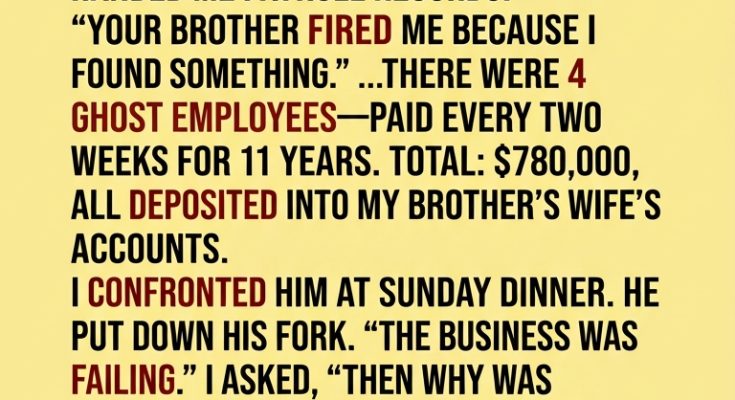
“Your brother fired me because I found something.”
I opened it.
Payroll records.
Four names appeared over and over again.
People I’d never heard of.
They were being paid every two weeks.
Same amounts.
Same dates.
For eleven years.
I checked the bank statements.
The payments totaled nearly $780,000.
And every check eventually went into accounts belonging to Daniel’s wife, Linda.
I felt sick.
“Are you sure?”
Maria nodded.
“I kept copies because I knew someday someone would need them.”
That Sunday, I confronted Daniel at our family dinner.
Everyone was there.
I put the payroll records on the table.
Daniel stopped eating.
“The business was failing,” he said quietly.
I looked directly at him.
“Then why were $780,000 paid to employees who don’t exist?”
Linda suddenly became very interested in her plate.
My father said nothing.
My mother lifted her glass with trembling hands.
Then she whispered:
“Leave it alone.”
I turned toward her.
“You knew?”
She took a sip of water.
Then she looked at me.
“Your brother isn’t the only one on that payroll.”
My stomach dropped.
“What are you talking about?”
Mom slowly reached into her purse.
She pulled out a folded piece of paper.
“I found this years ago.”
She placed it in front of me.
It was a payroll report.
At the bottom were the four ghost employees.
And underneath them was a fifth name.
Mine.
I stared at it.
My name.
Payments had been made to me every two weeks for almost eleven years.
Total:
$186,000.
I looked at my mother.
“I never received this money.”
“I know,” she said.
Daniel suddenly stood up.
“Mom, stop.”
But she continued.
“He created the fake employees to move money out of the restaurant. Your name was added because he needed a legitimate family member attached to part of the scheme.”
I turned toward Daniel.
“You used my identity?”
He didn’t answer.
Then Mom said something that changed everything.
“The money wasn’t all going to Linda.”
She pulled out another envelope.
Inside were copies of transfers.
The $780,000 had been divided between several accounts.
Linda had received some.
Daniel had received some.
But a large portion had been transferred into an account controlled by our father.
I looked at Dad.
He finally spoke.
“Daniel told me the restaurant was in trouble. He said if we didn’t take money out quietly, we’d all lose everything.”
“You knew?”
He lowered his eyes.
“I knew about the money.”
Daniel slammed his hand on the table.
“You don’t understand!”
I stood up.
“No. I understand perfectly.”
I called Maria the next morning.
Then I called an accountant.
Then a lawyer.
Within weeks, the truth came out.
The four ghost employees were completely fabricated.
My identity had been used without my knowledge.
Daniel had created fake payroll expenses to siphon money from the restaurant, while my parents had helped hide portions of the money because they believed they were protecting the family.
But there was one thing Daniel hadn’t expected.
The restaurant’s bank had records going back twenty-two years.
Once investigators started digging, they discovered the restaurant had actually made enough money to be debt-free.
The $340,000 debt was mostly the result of money Daniel had secretly removed and expenses he had falsified.
Daniel eventually admitted what he’d done.
He had convinced himself that because it was a family business, the money was “his.”
He’d used the stolen money to pay off personal loans, buy investments, and fund an expensive lifestyle.
Linda cooperated with investigators after realizing Daniel had lied to her about where much of the money came from.
My parents returned what they could.
Daniel was ordered to repay hundreds of thousands of dollars and faced criminal charges for fraud and identity theft.
As for me, I kept the restaurant.
I also kept Maria.
She became our office manager.
One afternoon, she handed me the first legitimate payroll report we’d produced in years.
Five names.
All real.
All employees who actually worked there.
I looked at it and smiled.
For the first time in twenty-two years, I knew exactly where every dollar was going.
And I finally understood why my mother had whispered:
“Leave it alone.”
She wasn’t protecting Daniel from me.
She was afraid of what I would discover about all of them.