THE GIRL SHE NEVER FORGOT
I was sitting in the hospital cafeteria at 11 PM when a stranger sat across from me.
My father was upstairs with pneumonia.
I hadn’t slept properly in three days.
The coffee tasted like burnt cardboard.
The man sitting across from me looked exhausted.
His eyes were red.
His hands were shaking slightly.
“My wife is having brain surgery,” he said.
I nodded.
“Nine hours so far.”
I didn’t know what to say.
So I said the only thing I could.
“That’s a long time.”
He nodded.
“Too long.”
We talked.
For two hours.
About his wife.
My father.
Hospital food.
Bad coffee.
The strange way hospitals make time feel like it has stopped.
Eventually, he pulled out his phone.
“Can I show you something?”
He showed me a photograph.
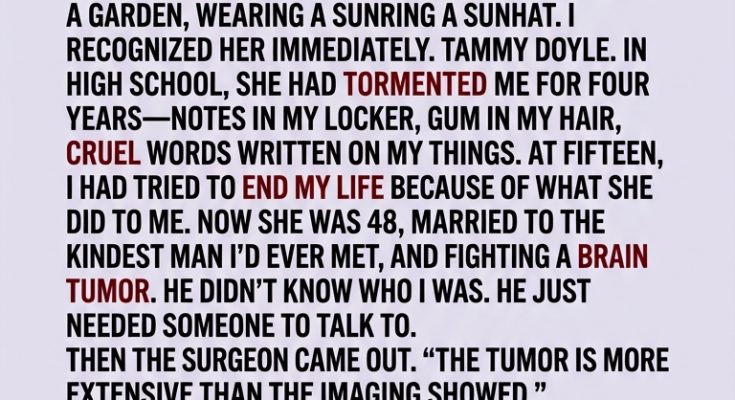
A woman stood in a garden wearing a sunhat.
She was smiling.
I recognized her immediately.
My stomach dropped.
Tammy Doyle.
I hadn’t seen her in thirty years.
But I remembered her.
Everyone remembers the person who taught them to be afraid of walking into a classroom.
Tammy had tormented me throughout high school.
Notes in my locker.
Cruel words written on my notebooks.
Gum in my hair.
Rumors whispered behind my back.
Things stolen.
Things destroyed.
Sometimes she didn’t even need an audience.
She’d simply walk past me and say something cruel enough to ruin my entire day.
At fifteen, I became so overwhelmed that I tried to end my life.
I survived.
But something in me never completely returned to the person I’d been before.
I spent years trying to forget Tammy Doyle.
And there she was.
On a stranger’s phone.
Older.
Smiling.
Human.
Her husband didn’t know who I was.
He didn’t know what she’d done.
He just needed someone to talk to.
So I listened.
He told me about their marriage.
Thirty years together.
Their garden.
The way Tammy sang while cooking.
How she always bought too many books.
How she cried at animal rescue commercials.
I listened to a man describe the woman who had once made my teenage life unbearable.
And the strangest thing happened.
I didn’t feel hatred.
I felt something else.
Sadness.
Not for Tammy.
For the fifteen-year-old girl I’d been.
At 1 AM, a surgeon came into the waiting area.
The man stood immediately.
The surgeon looked tired.
“The tumor is more extensive than the imaging showed.”
The man’s face collapsed.
He grabbed my hand.
I didn’t even realize he’d done it.
“Will you come with me?”
I looked at him.
“I can’t hear this alone.”
So I went.
We sat together while the surgeon explained what would happen next.
There were risks.
Possible complications.
A long recovery.
No guarantees.
The man kept staring at the floor.
Then he whispered:
“She always says she doesn’t deserve good people.”
I looked at him.
He continued.
“She says the worst thing she ever did was in high school.”
My heart began pounding.
He rubbed his eyes.
“She said the girl’s name was…”
He stopped.
Then looked at me.
“Sarah.”
Everything inside me went cold.
I didn’t say anything.
He stared at me.
“That’s you, isn’t it?”
I nodded.
His face changed.
“Oh God.”
He stood up.
“I had no idea.”
“I know.”
“She never told me.”
“I know.”
He looked toward the operating room.
“Why didn’t you tell me?”
I took a breath.
“Because this isn’t about me.”
He stared at me.
“She nearly destroyed you.”
“Yes.”
“You tried to…”
“I know.”
He sat down.
Tears ran down his face.
“I don’t know what to say.”
“You don’t have to say anything.”
He covered his face.
After several minutes, he whispered:
“Do you hate her?”
I thought about it.
Thirty-three years ago, I would have said yes.
But sitting beside her husband in a hospital at two in the morning, I realized something.
Hatred had taken enough from me.
“No,” I said.
He looked at me.
“I don’t hate her.”
“Can you forgive her?”
I looked through the glass toward the operating room.
“I don’t know.”
And that was the truth.
Forgiveness isn’t something you can manufacture because someone is sick.
You can’t erase pain because a person is dying.
You can’t tell a survivor that what happened doesn’t matter.
What Tammy had done mattered.
It had changed me.
But I didn’t want what she’d done to control the rest of my life.
The surgery lasted another four hours.
When the surgeon finally came out, Tammy was alive.
The tumor had been removed as much as safely possible.
She was going to need treatment.
And time.
Her husband broke down in relief.
I stepped back.
He hugged me.
Then he whispered:
“Thank you for staying.”
“I couldn’t leave.”
He looked at me.
“Why?”
I thought about the answer.
“Because once upon a time, I needed someone to stay.”
He cried harder.
The next morning, Tammy woke up.
She was confused.
Her husband sat beside her.
I stayed outside.
I didn’t know if I should go in.
Then her husband came into the hallway.
“She asked for you.”
My heart stopped.
“What?”
“She knows you’re here.”
I walked into the room.
Tammy looked at me.
For a few seconds, neither of us spoke.
She looked older than the photograph.
Fragile.
Her head was wrapped in bandages.
But her eyes were the same.
Then she whispered:
“Sarah?”
I nodded.
Tears filled her eyes.
“I wondered if I’d ever see you.”
I pulled a chair beside her bed.
“You knew?”
“I knew the moment my husband told me.”
She swallowed.
“I recognized your name.”
I looked at her.
“I didn’t recognize you at first.”
She smiled sadly.
“That’s okay.”
She closed her eyes.
“I’ve remembered you for thirty-three years.”
I didn’t know what to say.
Then she said:
“I was horrible.”
“Yes.”
She nodded.
“I don’t want you to tell me it wasn’t that bad.”
“I won’t.”
“I don’t want you to tell me you forgive me.”
“I won’t.”
She opened her eyes.
“Thank you.”
That surprised me.
“Why?”
“Because you’re letting me tell the truth.”
She took a breath.
“I was jealous of you.”
I frowned.
“Why?”
“You were kind.”
I almost laughed.
“You tortured me because I was kind?”
“No.”
She shook her head.
“I hated myself. And you were everything I wished I could be.”
I didn’t understand.
She continued.
“You had friends who actually loved you. Teachers liked you. You were good at things without making people afraid of you.”
She started crying.
“And I was miserable.”
“That doesn’t excuse anything.”
“I know.”
“Being miserable doesn’t give you permission to hurt someone.”
“I know.”
There was silence.
Then she said:
“I found your old yearbook once.”
I stared at her.
“I wrote something inside it.”
“What?”
“I wrote that I hoped you would disappear.”
My stomach tightened.
She looked away.
“I’ve regretted those words every day since.”
I didn’t know what to say.
Then she whispered:
“I’m sorry.”
Not dramatic.
Not rehearsed.
Just two words.
The words I had once imagined hearing a thousand times.
And when they finally came, they didn’t magically repair anything.
They didn’t erase fifteen.
They didn’t erase the hospital.
They didn’t erase the years I’d spent rebuilding myself.
But they did something else.
They gave the past a name.
It was wrong.
She had been wrong.
And I had survived.
I reached for her hand.
She looked surprised.
“I can’t give you back those years,” she whispered.
“No.”
“I wish I could.”
“I know.”
“Will you ever forgive me?”
I looked at her.
“Maybe.”
She nodded.
“I’ll take maybe.”
I smiled.
“That’s all I can give you today.”
Three weeks later, my father recovered from pneumonia.
Tammy began rehabilitation.
Her husband and I stayed in contact.
At first, it was because he needed help.
Then it became something unexpected.
Friendship.
Not with Tammy.
With him.
He sent me pictures of the garden.
He told me when Tammy took her first walk.
When she laughed again.
When she complained about hospital food.
One afternoon, he called.
“She’s asking about you.”
I smiled.
“What does she want?”
“She wants to know if you’ll come see the garden when she’s better.”
I thought about it.
Then said:
“Yes.”
Months later, I stood in Tammy’s garden.
The same kind of garden from the photograph.
Sunflowers.
Tomatoes.
Roses.
Tammy walked slowly beside me.
She had lost some strength.
But she was alive.
We stopped beside a rosebush.
“I planted this after surgery,” she said.
“For what?”
“For you.”
I looked at her.
She smiled.
“I needed something that could grow after something terrible.”
I touched the rose.
“You don’t owe me a rose.”
“I know.”
“Then why plant it?”
She thought for a moment.
“Because I want to spend the rest of my life becoming someone you wouldn’t have been afraid of.”
That sentence stayed with me.
I didn’t suddenly forget.
I didn’t suddenly love her.
But I understood something.
Forgiveness wasn’t saying:
“What you did was okay.”
It was saying:
“What you did doesn’t get to own me anymore.”
Before I left, Tammy called after me.
“Sarah?”
I turned.
“I know I don’t deserve your forgiveness.”
I waited.
“But thank you for giving me the chance to earn your trust.”
I nodded.
“That’s different.”
She smiled.
“I know.”
I walked toward the gate.
Her husband was waiting outside.
He smiled.
“You okay?”
I looked back at the garden.
Then at him.
“Yes.”
And I realized something I had never expected.
The girl who had once made me afraid to walk into a classroom had become a woman I could walk away from without fear.
I didn’t forgive her because she was sick.
I didn’t forgive her because her husband asked.
I didn’t forgive her because the past suddenly didn’t matter.
I forgave her because I had spent enough of my life carrying what she had done.
And sometimes healing doesn’t mean forgetting the wound.
Sometimes it simply means finally putting down the weight you were never supposed to carry forever.