MY MOTHER-IN-LAW TOOK MY DAUGHTERS’ DINNER AWAY—AND MY HUSBAND TOLD ME NOT TO MAKE A SCENE
For eleven years, the Holloways treated me like a burden.
They never said it directly.
They didn’t have to.
It was in the way Constance Holloway looked at my clothes.
The way Grant’s brothers laughed whenever I mentioned my “little job.”
The way Grant’s friends assumed he paid for everything.
And especially the way my husband talked about me when he thought I couldn’t hear.
“She doesn’t really work,” he’d say.
“She just helps a little with bookkeeping.”
That “little job” had started in my apartment eleven years earlier.
I had built a consulting business from a laptop and a folding table.
Over the years, it had grown.
Quietly.
I never told Grant how much it was worth.
Not because I wanted to deceive him.
Because every time I tried to talk about my business, he laughed.
“Come on, Emily.”
“You’re not exactly running Microsoft.”
So I stopped explaining.
I let him believe what he wanted.
Then came the night that changed everything.
Grant’s family was celebrating the anniversary of the Holloway Foundation at their enormous estate.
There were hundreds of guests.
Crystal chandeliers.
Live music.
A private chef.
Champagne flowing through the ballroom.
Our daughters, Lily and Sophie, were eight and six.
They were excited.
They had been looking forward to the dinner all week.
When their plates arrived, they smiled.
“Mommy, look!”
Lily pointed at the mashed potatoes.
Sophie giggled.
For a few minutes, everything was normal.
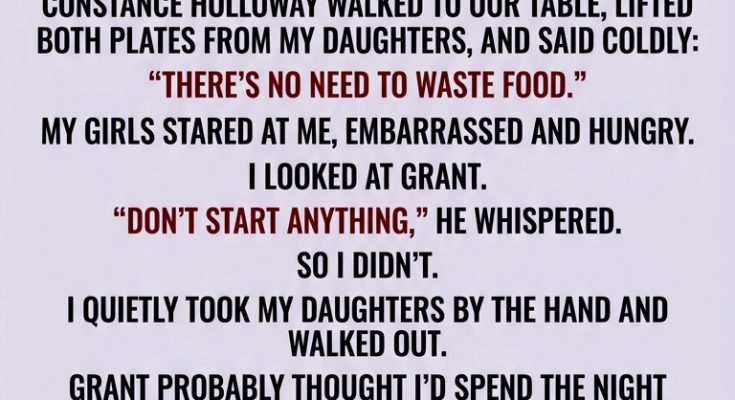
Then Constance appeared.
She looked at my daughters’ plates.
Without saying a word, she picked up Lily’s.
Then Sophie’s.
My girls stared at her.
Constance said coldly,
“There’s no need to waste food.”
Sophie looked confused.
“But Grandma, I’m hungry.”
“You’ve had enough.”
She walked away with both plates.
My daughters looked at me.
Lily’s eyes filled with tears.
“Mommy?”
I looked at Grant.
“Don’t start anything,” he whispered.
Something inside me went completely still.
I didn’t argue.
I didn’t shout.
I didn’t embarrass anyone.
I simply stood.
Took my daughters by the hands.
And walked out.
In the car, Lily asked,
“Mommy, did Grandma not want us there?”
I swallowed.
“She doesn’t get to decide how loved you are.”
Sophie looked at me.
“Are we going home?”
I smiled.
“Yes.”
“But Dad?”
“He can stay.”
That was the first time my daughters saw me leave without waiting for their father.
And it was the first time I understood that I couldn’t keep pretending his family’s behavior was harmless.
We didn’t go to our apartment.
We drove across town.
Through a private gate.
Past a security booth.
Down a long driveway.
And toward a modern glass house overlooking the lake.
Sophie looked out the window.
“Whose house is that?”
I smiled.
“Ours.”
The girls stared at me.
“What?”
I opened the front door.
“Welcome home.”
They ran inside.
They had never seen it before.
Because I had never brought them there.
For years, I had quietly purchased the property through my company.
It was my private home.
My safe place.
And it had been waiting for them.
The next morning, Grant arrived at our apartment.
Empty.
No clothes.
No children.
No furniture.
He called me.
“Where are you?”
“Home.”
“What do you mean?”
“Our real home.”
He was silent.
“Emily, where are the girls?”
“With me.”
“You can’t just take them.”
“I didn’t take them.”
I paused.
“They left with their mother.”
He became angry.
“Come back.”
“No.”
“Stop being dramatic.”
“No.”
Then he said the sentence that would haunt him.
“You’re dependent on me.”
I almost laughed.
“Am I?”
“Yes.”
“You really believe that?”
“I know it.”
I smiled.
“Then come find me.”
An hour later, Grant arrived at the lake house.
He stepped through the front door.
And froze.
The house was enormous.
Floor-to-ceiling windows.
A private dock.
A home office.
A children’s wing.
A security system.
Everything beautifully furnished.
He looked around.
Then at me.
“Whose house is this?”
“Mine.”
He laughed nervously.
“No.”
“Yes.”
“You can’t afford this.”
I looked at him.
“You’ve been saying that for eleven years.”
He stared at me.
Then he noticed the framed certificate on the wall.
My company.
The same company he’d called my “little job.”
Except the certificate listed the company as a majority owner of several major properties.
Grant’s face changed.
“What is this?”
“My company.”
“How much is it worth?”
I didn’t answer.
He pulled out his phone.
Then his expression changed again.
“Emily…”
“What?”
“Is this you?”
He was looking at a business article.
My photograph.
My name.
The headline:
LOCAL ENTREPRENEUR BUILDS PRIVATE LOGISTICS FIRM INTO MULTI-MILLION-DOLLAR COMPANY.
Grant stared at the screen.
“You never told me.”
“I tried.”
“You said you did bookkeeping.”
“I did bookkeeping.”
“For yourself?”
“Yes.”
He looked around the room.
“You own all this?”
“Some of it.”
“Some?”
I nodded.
Then I told him the truth.
My company had become one of the largest independent logistics providers in the region.
And the Holloway family business was one of our biggest clients.
Grant stared at me.
“What does that have to do with my family?”
I looked at him.
“Everything.”
For years, Holloway Industries had been struggling.
They had lost several major contracts.
Their distribution network was outdated.
Their biggest investor had given them six months to turn things around.
And three days earlier, their board had approved a merger proposal.
With my company.
Grant had never known.
His father had.
His mother had.
They knew exactly who I was.
And they knew the company they desperately needed was mine.
That’s why Constance had always treated me strangely.
She didn’t know my full financial position.
But she knew I had influence.
And she had been terrified that I’d discover how dependent the Holloways actually were on my company.
Grant looked horrified.
“You’re the company we’re negotiating with?”
“Yes.”
His phone rang.
It was his father.
Grant answered.
“Dad?”
His father’s voice was frantic.
“Where is Emily?”
Grant looked at me.
“She’s here.”
“Put her on the phone.”
Grant handed it to me.
I answered.
“Mr. Holloway.”
His voice softened immediately.
“Emily, please.”
“Please what?”
“We need to finish the merger.”
I smiled.
“Do you?”
“You know how important this is.”
“I do.”
“We’re talking about hundreds of employees.”
“I know.”
“You can’t punish the company because of a family disagreement.”
I looked at Grant.
“I’m not punishing anyone.”
“Then you’ll approve the deal?”
“No.”
Silence.
“Why?”
“Because I won’t partner with a company whose leadership believes humiliating children is acceptable.”
Grant’s father sighed.
“Constance made a mistake.”
“She did.”
“I’ll make sure it never happens again.”
I looked at my daughters.
“That’s not enough.”
“What do you want?”
I answered calmly.
“Independent leadership.”
His voice went quiet.
“You want me to step down?”
“I want the board to appoint professional management.”
He didn’t respond.
I continued.
“Your family can keep its ownership stake.”
“But?”
“But your family doesn’t get operational control.”
A long silence followed.
Finally he said,
“I’ll discuss it with the board.”
“Good.”
I hung up.
Grant stared at me.
“You just took control of my family’s company.”
“No.”
I corrected him.
“They gave it away years ago.”
The merger went through.
Professional management took over.
The Holloway family remained wealthy.
But they no longer controlled the company.
Constance was removed from the foundation’s board.
Not because I demanded revenge.
Because the board finally reviewed years of financial decisions she had influenced.
And the problems were much bigger than one dinner.
As for Grant?
He came home that night.
He sat across from me.
“You could have told me.”
“I did.”
“No. You could have told me everything.”
I looked at him.
“Would you have believed me?”
He didn’t answer.
“I was your wife.”
“I know.”
“You should have believed me when I said I worked.”
“I was wrong.”
“You were.”
He looked toward the girls.
“They love me.”
“They do.”
“I don’t want to lose them.”
“Then be the father they deserve.”
He nodded.
“And you?”
I looked at him for a long time.
“I don’t know yet.”
We separated.
Not immediately.
But eventually.
Because the dinner wasn’t the real reason.
The real reason was eleven years of disrespect.
Eleven years of being told I wasn’t enough.
Eleven years of being treated as dependent because my husband never bothered to understand what I actually contributed.
The divorce was peaceful.
I kept my company.
My daughters stayed with me.
Grant remained part of their lives.
But he was no longer allowed to pretend that his family came first.
A year later, I hosted Thanksgiving at the lake house.
Lily helped me cook.
Sophie decorated the table.
There were no crystal chandeliers.
No giant family foundation event.
Just laughter.
Food.
And people who actually respected one another.
Before dinner, Sophie looked at me.
“Mommy?”
“Yes?”
“Can Grandma come next year?”
I smiled.
“If she can be kind.”
Sophie nodded.
“Okay.”
Then Lily took my hand.
“I’m glad we came home that night.”
I kissed her forehead.
“So am I.”
Because that night, Constance thought she was taking dinner away from my daughters.
Grant thought I was too dependent to do anything.
And the Holloways thought they owned the world around them.
They were wrong.
The woman they had spent eleven years mocking wasn’t helpless.
She wasn’t dependent.
She wasn’t small.
She had simply stopped explaining herself to people who had no intention of listening.
And the greatest lesson I ever taught my daughters wasn’t about money.
It was this:
Never stay at a table where someone has to convince you that you deserve a seat.
Sometimes the strongest thing you can do…
is quietly stand up…
take your children by the hand…
and walk away.