MY PARENTS TRIED TO GIVE MY CHICAGO APARTMENT TO MY SISTER—THEN THE ATTORNEY SHOWED UP AT MY DOOR
The attorney thought he was coming to my Chicago condo to complete a family property transfer.
He thought I had already agreed.
He thought the paperwork was routine.
He was wrong about all three.
I opened the door that Tuesday afternoon and found a man in a navy suit standing on my doorstep.
He held a thick leather folder.
“Mr. Bennett?”
“Yes?”
“My name is Richard Hale. I’m an attorney representing your parents.”
My stomach tightened.
“My parents?”
He nodded.
“I believe we’re here to finalize the transfer of this property.”
I stared at him.
“What transfer?”
He looked confused.
“The transfer of this condominium to your sister, Kelsey.”
I almost laughed.
Then I realized he was serious.
“I never agreed to give my apartment to anyone.”
His expression changed.
“You didn’t?”
“No.”
He slowly closed the folder.
“Your parents told me you had already agreed.”
I looked past him.
My parents were standing near the elevator.
My mother wouldn’t look at me.
My father looked furious.
The attorney turned toward them.
“You told me he had already agreed.”
Silence.
And suddenly, I understood.
My parents hadn’t misunderstood me.
They had lied.
The story actually started three weeks earlier.
My younger sister, Kelsey, had graduated from college.
My parents wanted to give her something special.
Apparently, that something was my home.
At Sunday dinner, my mother raised her glass.
“To Kelsey.”
Everyone smiled.
Then she said:
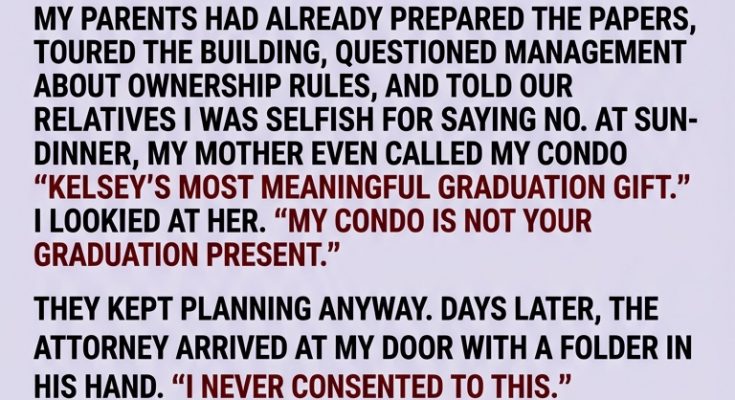
“To her most meaningful graduation gift.”
I looked at her.
“What gift?”
She smiled.
“The condo.”
I laughed because I thought she was joking.
“My condo?”
“Yes.”
I put down my fork.
“My condo is not Kelsey’s graduation present.”
My father frowned.
“Don’t be difficult.”
“I’m not.”
“You don’t need that place.”
I stared at him.
“It’s my home.”
“Kelsey needs somewhere to live.”
“So do I.”
“She’ll be starting her career.”
“So am I.”
My mother sighed.
“You’re always thinking about yourself.”
I looked at Kelsey.
She hadn’t said a word.
Finally, she whispered:
“I didn’t ask for it.”
My mother immediately snapped:
“Don’t be modest.”
I shook my head.
“This conversation is over.”
Apparently, it wasn’t.
Over the next two weeks, my parents acted as if the condo already belonged to Kelsey.
They toured the building with her.
They asked management about parking.
They measured rooms.
They discussed furniture.
My mother even told relatives that I was being selfish.
One aunt called me.
“I heard you’re refusing to help your sister.”
“Who told you that?”
“Your mother.”
I laughed.
“She’s trying to give away my home.”
My aunt went quiet.
“That doesn’t sound right.”
“It isn’t.”
Then my mother started sending me messages.
Kelsey really needs this.
You can buy another place.
You’re making this unnecessarily difficult.
I stopped responding.
I thought eventually they’d realize how absurd it was.
They didn’t.
Then the attorney appeared.
After he confronted my parents in the hallway, he turned back to me.
“May I come inside?”
I stepped aside.
He entered.
My parents followed.
The atmosphere was unbearable.
Richard opened his folder.
“I need to understand something.”
He looked at me.
“Did you sign any agreement transferring ownership?”
“No.”
“Did you authorize your parents to sign on your behalf?”
“No.”
“Did you verbally agree to the transfer?”
“No.”
He looked at my parents.
“Then I don’t understand why I’m here.”
My father stepped forward.
“He agreed months ago.”
I stared at him.
“No, I didn’t.”
“You told us you didn’t need it.”
“That isn’t permission.”
“You said you wanted to move someday.”
“That isn’t permission either.”
My father became angry.
“You’re deliberately making this difficult.”
I looked at him.
“You tried to give away my home.”
My mother interrupted.
“We’re family!”
I answered:
“Family doesn’t get to transfer property they don’t own.”
Richard slowly nodded.
“That’s correct.”
Then he asked for the original title documents.
I handed him the copies I kept in my safe.
He examined them.
Then his expression became even more serious.
“Mr. Bennett, you are the sole registered owner.”
My father scoffed.
“We know that.”
Richard looked at him.
“Then why did you instruct me to prepare a transfer without his consent?”
My father said nothing.
My mother stepped forward.
“We thought he would cooperate.”
Richard shook his head.
“That’s not how property transfers work.”
Kelsey finally spoke.
“Mom, Dad… I told you I didn’t want his apartment.”
My mother looked at her.
“Don’t be ridiculous.”
“No.”
Kelsey’s voice became firmer.
“I mean it.”
She looked at me.
“I’m sorry.”
I nodded.
“Thank you.”
Richard gathered his papers.
But before leaving, he asked me a strange question.
“Have your parents ever had access to your financial documents?”
I thought about it.
“Yes.”
“When?”
“Last year, when I refinanced.”
He nodded slowly.
“Then I’d recommend you review your records.”
“Why?”
He hesitated.
“Because some of the documents they provided me contained financial information I would not normally expect them to have.”
My stomach tightened.
“What kind of information?”
“Your mortgage balance.”
I looked at my parents.
My father looked away.
“And your account numbers.”
That made my blood run cold.
“Account numbers?”
Richard nodded.
“They were included in a financial statement attached to their instructions.”
I immediately went to my computer.
I checked my accounts.
Nothing seemed wrong.
But then I checked my email.
There was something strange.
Three months earlier, someone had attempted to reset the password on my mortgage account.
The request had been sent from an email address I didn’t recognize.
I looked at the address.
It was my mother’s old email.
I turned around.
“Mom?”
She froze.
“Why did you try to access my mortgage account?”
“I didn’t.”
“The reset request came from your email.”
“I don’t know anything about that.”
I looked at my father.
“Did you?”
He said nothing.
Richard stepped between us.
“I think we should stop here.”
He took out his phone.
“I will be contacting my firm’s compliance department.”
My father immediately became defensive.
“There’s no need for that.”
Richard looked at him.
“There absolutely is.”
The following week, everything changed.
Richard withdrew from representing my parents.
He also sent me a letter explaining that he had received instructions based on information that appeared to misrepresent my consent.
I hired my own attorney.
We reviewed everything.
The property.
The attempted account access.
The documents.
The emails.
And then we discovered the biggest problem.
My parents had signed a declaration stating that I had voluntarily agreed to transfer the condo.
They had signed it themselves.
Not me.
My signature was nowhere on it.
My attorney looked at the document.
“This could become very serious.”
I nodded.
“What should I do?”
“Document everything.”
So I did.
My parents eventually admitted what happened.
They hadn’t forged my signature.
They had done something almost as reckless.
They had convinced themselves that because they were my parents, they had the right to make the decision.
They believed I would eventually give in.
My father said:
“We thought you would come around.”
I answered:
“You planned everything before asking me.”
My mother cried.
“We wanted to help Kelsey.”
“You could have helped her with your own money.”
Silence.
That was the part they couldn’t answer.
They had wanted to be generous.
But they wanted to be generous with something that belonged to me.
The family divided almost immediately.
Some relatives blamed me.
Others blamed my parents.
Then Richard sent a formal letter to everyone involved.
It explained the ownership.
The attempted transfer.
The lack of authorization.
And the fact that I had never consented.
After that, the phone calls stopped.
My aunt apologized.
Two cousins apologized.
Even Kelsey came to my condo.
She stood at the door.
“I really am sorry.”
“You don’t have to apologize.”
“I do.”
She looked around.
“I never wanted this.”
“I know.”
She smiled sadly.
“I just wanted Mom and Dad to stop treating me like I couldn’t build a life myself.”
That sentence stayed with me.
Because I finally understood.
They weren’t only controlling my life.
They were controlling hers too.
Kelsey moved into a small apartment of her own.
She got a job.
Started paying her own bills.
And slowly became independent.
My parents were furious at first.
Then embarrassed.
Eventually, they apologized.
My father came to my condo one evening.
He stood at the door for a long time.
“I was wrong.”
I let him finish.
“We crossed a line.”
“Yes.”
“We had no right.”
“No.”
He nodded.
“I know.”
Then he said:
“I thought because I was your father, I could make decisions for you.”
I looked at him.
“That’s exactly what you did.”
He sighed.
“I understand now.”
I didn’t sell the condo.
I didn’t move.
I stayed.
Not because of the property value.
Because it was the first place I had ever owned completely on my own.
I had worked for it.
Saved for it.
Signed the mortgage.
Paid every payment.
It represented something far more important than four walls.
It represented independence.
And nobody—not even my parents—was entitled to take that away.
Months later, Kelsey visited me.
She brought coffee.
We sat by the window overlooking Chicago.
She laughed.
“Do you know what Mom said last week?”
“What?”
“She told me your condo would’ve been too expensive for me anyway.”
I laughed.
“Sounds like Mom.”
Kelsey smiled.
“I’m glad I didn’t take it.”
“Why?”
“Because I want the first home I own to actually be mine.”
I looked at her.
“That’s probably the smartest thing you’ve ever said.”
She smiled.
“I learned from you.”
I still think about that attorney standing on my doorstep.
He came believing he was there to complete a simple family transfer.
Instead, he discovered that the entire transaction was based on a lie.
My parents thought they could make a decision for me because I was their child.
They forgot one important fact.
I was an adult.
And the apartment they were giving away wasn’t theirs.
It was mine.
They thought they were taking something from me.
What they actually gave me was something much more valuable.
The courage to establish boundaries with the people I loved most.
Because family should never mean surrendering your rights.
And when the attorney looked at my parents and said,
“You told me he had already agreed.”
Nobody in that room had an answer.
Because the truth was simple.
I had never agreed.
And sometimes, the most powerful word in a family argument isn’t yes.
It’s the one word they never expected you to say:
“No.”