AFTER MY HUSBAND DIED, I HID MY $500 MILLION INHERITANCE—THEN I LEARNED WHO REALLY RESPECTED ME
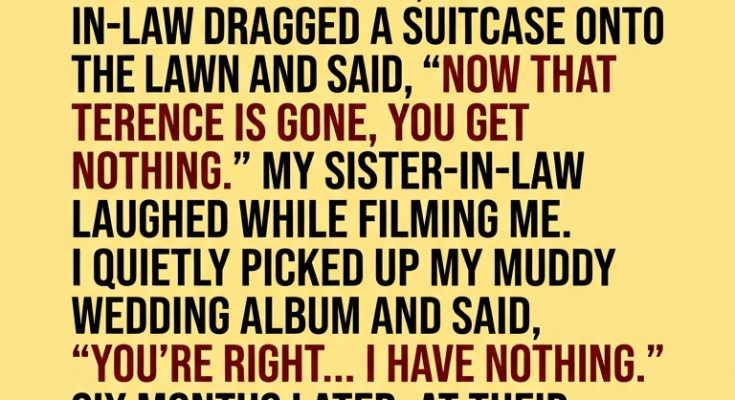
Twenty-four hours after my husband Terence’s funeral, my mother-in-law arrived at my house carrying a suitcase.
She didn’t come to comfort me.
She came to remove me.
She dragged the suitcase across the lawn, stopped in front of the porch, and looked at me with cold satisfaction.
“Now that Terence is gone,” she said, “you get nothing.”
Behind her, my sister-in-law was filming everything on her phone.
She laughed.
“Go ahead, cry. This is going to be hilarious.”
I stood there in the clothes I’d worn to my husband’s funeral.
My hands were still shaking.
My wedding ring was still on my finger.
And my husband’s photograph was still sitting beside the front door.
I could have fought.
I could have told them what Terence had left me.
Instead, I bent down and picked up my wedding album.
It had fallen into the mud when my mother-in-law threw my belongings onto the lawn.
I wiped the cover with my sleeve.
Then I looked at her.
“You’re right.”
She smiled.
I took a breath.
“I have nothing.”
She laughed.
Then she drove away.
She never knew those four words were the beginning of the test.
Terence had left me something no one in his family knew about.
Not the house.
Not the cars.
Not the jewelry.
Something much bigger.
A fortune worth approximately $500 million.
It wasn’t money we’d talked about publicly.
Terence had inherited it through a private family trust shortly before his death.
And before he died, he’d transferred control of the trust to me.
There was only one reason I hadn’t told anyone.
Because I’d spent thirty-one years watching how people treated those who couldn’t give them anything.
Terence and I had discussed it during one of our last conversations.
“If something happens to me,” he’d said, “don’t tell them immediately.”
“Why?”
He smiled sadly.
“Because you’ll finally see who loves you… and who loves what they think I can give them.”
I thought he was being paranoid.
After his funeral, I realized he wasn’t.
For six months, I lived quietly.
I rented a small apartment.
I drove an ordinary car.
I stopped wearing expensive jewelry.
I let everyone believe my financial situation was exactly what my mother-in-law had claimed.
Nothing.
And the reactions were revealing.
My sister-in-law stopped calling me.
My husband’s cousins stopped inviting me anywhere.
People who had once asked me for favors suddenly couldn’t remember my phone number.
But some people stayed.
Our old housekeeper, Maria, brought groceries twice.
Terence’s childhood friend called every Sunday.
And my husband’s youngest cousin, Daniel, sent me a message that simply said:
“I don’t care what happened with the estate. Are you eating?”
I saved that message.
Meanwhile, Terence’s family became increasingly confident.
They announced a massive charity gala six months after his death.
It was supposed to celebrate the family’s generosity.
The guest list included investors, celebrities, business leaders, and dozens of people who had ignored me after the funeral.
My mother-in-law was the guest of honor.
My sister-in-law was helping organize the event.
Photos of them appeared everywhere.
They were smiling.
Posing.
Talking about the family’s “legacy.”
And apparently, they’d already begun telling people that Terence had left them everything.
One article even referred to my mother-in-law as the person “continuing the Terence Hayes family legacy.”
I read it once.
Then closed my laptop.
I wasn’t angry.
I was waiting.
The night of the gala arrived.
The ballroom was covered in white flowers.
Crystal chandeliers hung above hundreds of guests.
My mother-in-law stood near the stage in a diamond necklace I’d once given her.
My sister-in-law was beside her, laughing.
Then the lights dimmed.
A video began playing.
It showed Terence.
Old photographs.
Family vacations.
Business achievements.
Charity events.
Then my mother-in-law appeared onstage.
She spoke about grief.
About family.
About sacrifice.
About how difficult it had been to carry on after Terence’s death.
Then she said:
“Terence would have wanted us to continue building the legacy he left behind.”
The crowd applauded.
I stood at the back of the room.
Nobody recognized me.
Until I started walking toward the stage.
My sister-in-law saw me first.
Her smile disappeared.
She whispered something to my mother-in-law.
My mother-in-law turned.
Her face changed.
The ballroom slowly went quiet.
I continued walking.
No security stopped me.
I’d been invited by someone they didn’t realize had access to the guest list.
I reached the microphone.
My mother-in-law stared at me.
“What are you doing here?”
I looked at her.
Then at the crowd.
Then at the giant screen behind us showing Terence’s face.
I thought about the muddy wedding album.
The suitcase on my lawn.
My sister-in-law laughing while filming me.
Six months of pretending I had nothing.
Then I said one sentence.
“You’re right—I inherited nothing from Terence, because he left everything to me.”
The room went completely silent.
My mother-in-law’s face turned white.
My sister-in-law dropped her phone.
Someone in the crowd whispered:
“Everything?”
I nodded.
“Everything.”
My attorney stepped forward.
He carried a black folder.
He placed it on the podium.
Inside were the trust documents.
The final estate plan.
The transfer of control.
And the documentation showing exactly who legally owned what.
My mother-in-law stared at the papers.
“This can’t be real.”
I looked at her.
“It is.”
She turned toward the crowd.
“She manipulated him!”
My attorney calmly interrupted.
“The documents were executed while Mr. Hayes was fully competent and were independently witnessed.”
Nobody spoke.
Then my sister-in-law whispered:
“You knew?”
I looked at her.
“I knew six months ago.”
“Then why didn’t you say anything?”
I thought about her phone recording me on the lawn.
“Because I wanted to know who would treat me like I was worth nothing when they thought I had nothing.”
The room became uncomfortable.
Some guests quietly stepped away from my mother-in-law.
Others began whispering.
My mother-in-law walked toward me.
“You let us believe you were poor.”
“No.”
I shook my head.
“You told everyone I was.”
She stopped.
I continued.
“I never claimed to have nothing.”
“You didn’t correct us!”
“No.”
I looked directly at her.
“Because every time you thought I had nothing, you showed me exactly who you were.”
She couldn’t answer.
Then something unexpected happened.
Daniel, Terence’s youngest cousin, stepped forward.
He looked at me.
“I knew she was hiding something.”
My mother-in-law glared at him.
“You knew?”
“No.”
He shook his head.
“I just knew she didn’t deserve what you did to her.”
He looked at the room.
“She was Terence’s wife for thirty-one years.”
Then he looked at me.
“And nobody even called to ask whether she was okay.”
Silence.
That mattered more to me than the money.
Because during those six months, I had learned something.
Money doesn’t reveal people’s character.
It reveals how quickly they are willing to change their behavior when they think your money is gone.
I didn’t take revenge.
I didn’t destroy their lives.
I didn’t throw them out of their homes.
Instead, I did something Terence would have appreciated.
I honored the promises he had made before he died.
A large portion of the inheritance went into a family foundation.
Another portion was placed into trusts for our grandchildren.
And I kept control of the assets he had specifically left to me.
As for my mother-in-law?
She received exactly what the legal estate plan provided.
Nothing more.
Nothing less.
Months later, I found the muddy wedding album again.
I’d had the cover restored.
The photographs inside were still slightly damaged.
I opened it to the first page.
Terence and I were standing outside the church.
Young.
Happy.
Completely unaware of everything that would happen later.
I ran my fingers over his photograph.
Then I remembered his final words.
“You’ll finally see who loves you… and who loves what they think I can give them.”
He was right.
But there was something else I learned.
The people who respected me when they thought I had nothing were the ones who deserved to know what I really had.
Everyone else?
They had already shown me enough.
I closed the album.
And for the first time since Terence died, I smiled.
Not because I had inherited $500 million.
But because I had discovered something worth far more.
The people who stayed when they thought I had nothing were the people I finally knew I could trust.