THE NOTES IN THE LUNCHBOX
For three weeks, my nine-year-old son, Noah, had been bringing his lunch home untouched.
At first, I blamed the cafeteria.
Maybe he didn’t like the food.
Maybe the other kids were trading snacks.
Maybe he was simply too busy playing during lunch.
Every afternoon, I’d open his lunchbox and find the sandwich exactly where I’d packed it that morning.
One day, I asked him about it.
“Did you eat anything today?”
He shrugged.
“Wasn’t hungry.”
“You’re always hungry.”
He looked down at the floor.
“I’m fine, Mom.”
That answer bothered me.
Noah had never been good at pretending.
But I didn’t know what he was hiding.
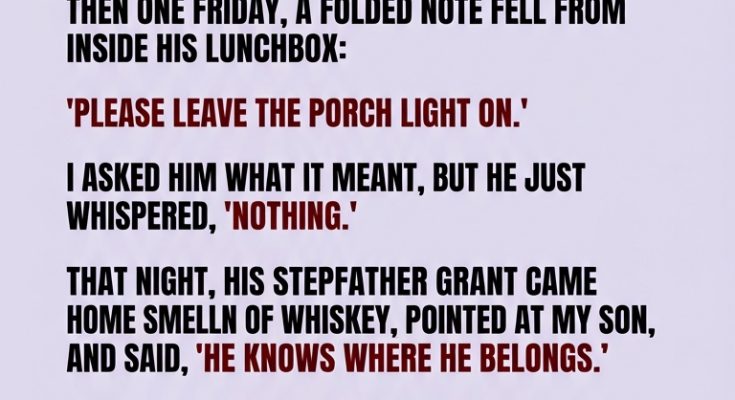
Then, one Friday afternoon, something fell from the inside of his lunchbox.
A small folded piece of paper.
I picked it up.
There were only six words written in childish handwriting.
PLEASE LEAVE THE PORCH LIGHT ON.
My stomach tightened.
“Noah?”
He froze.
“What does this mean?”
His eyes filled with fear.
“Nothing.”
“Who wrote this?”
“I don’t know.”
“You don’t know?”
He shook his head.
“Please, Mom. Don’t ask.”
That night, my husband Grant came home late.
The smell of whiskey followed him through the front door.
He barely looked at me.
Then his eyes landed on Noah.
“He knows where he belongs,” Grant said.
Noah immediately lowered his head.
I stared at Grant.
“What does that mean?”
Grant laughed.
“Nothing. You’re always looking for problems.”
Later, after Grant and Noah were asleep, I couldn’t stop thinking about the note.
I went downstairs.
Noah’s lunchbox was still on the kitchen counter.
I opened it.
The lining felt strangely thick.
I pulled at the edge.
Something slipped out.
Then another.
And another.
Nine folded notes.
Each one had a date written at the top.
I spread them across the table.
The first said:
HE SAID I WASN’T ALLOWED TO TELL YOU.
The second:
HE CHECKED THE DOOR BEFORE HE LEFT.
The third:
I HEARD HIM TALKING ABOUT THE HOUSE.
My hands began to shake.
The fourth:
HE SAID MOM WOULD NEVER BELIEVE ME.
The fifth:
HE HID SOMETHING IN THE GARAGE.
The sixth:
HE KNOWS I FOUND IT.
The seventh:
HE SAID IF I TALK, I’LL LOSE MY MOM.
The eighth:
I’M SORRY I DIDN’T TELL YOU SOONER.
The ninth was dated for the previous night.
I unfolded it.
MOM, IF HE LOCKS ME OUTSIDE AGAIN, LOOK UNDER THE—
The sentence stopped.
I stared at the unfinished page.
Then I heard a floorboard creak upstairs.
I quickly folded everything and put the notes back.
The next morning, I waited until Grant left for work.
Then I woke Noah.
He looked terrified when he saw the notes on the table.
“You wrote these?”
He nodded.
“Why didn’t you tell me?”
“Because Grant said you’d leave with me.”
My heart broke.
“What did he do?”
Noah began crying.
“He locked me outside when you were at work.”
“How many times?”
He held up three fingers.
“Where did he lock you?”
“The shed.”
I went cold.
“The shed?”
He nodded.
“He said I needed to learn where I belonged.”
I immediately called my sister and asked her to come over.
Then Noah and I went to the backyard.
The shed stood behind the garage.
I remembered the unfinished note.
LOOK UNDER THE…
I searched beneath the workbench.
Nothing.
Under the shelves.
Nothing.
Then Noah pointed toward the floor.
“Mom.”
One of the boards looked newer than the others.
I pulled it up.
Underneath was a small metal box.
Inside were documents.
Property records.
Bank statements.
Copies of insurance papers.
And a letter addressed to Grant.
I read it twice.
Grant had been secretly taking money from an account my late father had left me.
But there was something worse.
The property documents showed that he had been preparing paperwork to refinance our house without telling me.
He had also written notes about Noah.
One line made my blood run cold:
Need him to stay quiet until transfer is complete.
Suddenly, everything made sense.
The lunchbox notes.
The locked shed.
The strange comments.
The whiskey.
Grant wasn’t simply being cruel to Noah.
He had been using fear to control both of us while secretly trying to gain control of our home and money.
But there was one final document.
A signed statement from a lawyer.
It explained that Grant had attempted to obtain authorization to access my father’s inheritance by falsely claiming that I had agreed to give him control.
I immediately contacted the attorney whose name appeared on the paperwork.
Within hours, we had confirmed the documents were genuine.
I also contacted the police and made arrangements for Noah and me to stay somewhere safe.
That evening, Grant came home expecting everything to be normal.
Instead, he found two officers waiting outside.
His face changed when he saw them.
He looked at Noah.
Then at me.
“You actually believed him?”
I stepped forward.
“I believed my son.”
Grant’s expression hardened.
“You’re destroying this family.”
I shook my head.
“No. You did that when you decided fear was more useful than honesty.”
The investigation that followed uncovered financial records, messages, and documents that confirmed much of what Noah had described.
Grant was eventually charged for the financial misconduct and other offenses related to his treatment of Noah.
But the most important thing happened long before the case ended.
Noah stopped blaming himself.
For months, he had believed that speaking up would destroy our family.
I told him something every night:
“You didn’t destroy anything. You saved us.”
We moved into my sister’s house temporarily while the legal issues were resolved.
Eventually, I returned to my home.
I repainted Noah’s bedroom.
I replaced the old porch light.
And every evening, before bed, I turned it on.
One night, months later, Noah stood beside me on the porch.
He looked at the light.
“Mom?”
“Yeah?”
“Do you remember my first note?”
I smiled.
“I remember.”
He took my hand.
“I wrote it because I didn’t know how to ask you for help.”
I squeezed his fingers.
“You never have to be afraid to ask me again.”
He nodded.
Then he smiled.
For the first time in months, it was the smile of a nine-year-old boy who finally felt safe.
I looked at the porch light glowing above us.
That little light had started as a secret message from a frightened child.
But in the end, it became something else.
A promise.
That no matter how dark things became, Noah would never again have to face the darkness alone.