The Bank Manager Froze My Account Because He Thought I Was Just Another Confused Old Woman—He Had No Idea Who I Really Was
The new branch manager froze my bank account on a Tuesday.
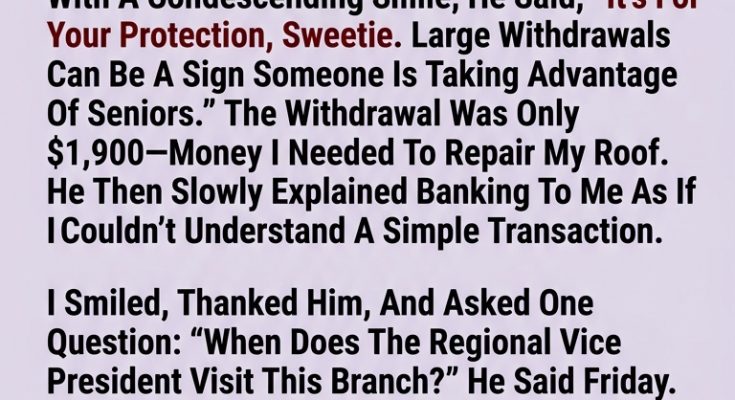
With a condescending smile, he leaned across his desk and said, “It’s for your protection, sweetie. Large withdrawals can be a sign someone is taking advantage of seniors.”
The withdrawal was only $1,900.
I needed the money to repair my leaking roof before the next storm arrived.
But apparently, to the young man sitting behind the manager’s desk, I was too old to decide what to do with my own money.
He even turned his computer monitor toward me and began explaining how bank accounts worked.
“Sometimes older customers don’t understand the risks of making large withdrawals. We have procedures to protect people like you.”
People like me.
I smiled politely.
“That’s very thoughtful of you,” I replied.
He seemed pleased with himself.
Then I asked one question.
“When does the regional vice president visit this branch?”
His smile widened.
“Friday. But I wouldn’t bother him with something like this. He has much more important responsibilities.”
I nodded.
“Of course.”
What he didn’t know was that I had worked at that very bank for thirty-one years.
I had started as a teller in 1978, worked my way through customer service, operations, compliance, and branch administration, and retired after training dozens of employees.
One of those employees was a young college graduate named Douglas.
I remembered him arriving at the bank in 1989 with an oversized tie, nervous hands, and a habit of apologizing every time he made a mistake.
I had taught him how to balance a drawer, handle difficult customers, recognize fraudulent transactions, and, most importantly, treat every customer with dignity.
Douglas was now the regional vice president.
And the young manager who had just frozen my account had absolutely no idea that the woman he was calling sweetie had once trained the man who would be reviewing his performance.
I didn’t argue.
I didn’t raise my voice.
I simply thanked him, collected my handbag, and walked out.
On Friday morning, I returned.
I wore my navy-blue suit, the pearl earrings my late husband had given me, and the same sensible shoes I had worn during my final years at the bank.
I sat quietly in the lobby.
At exactly 9:15, the front doors opened.
A tall man carrying a leather briefcase walked inside.
Douglas.
He was older now, with silver beginning to show at his temples, but I recognized him immediately.
He scanned the lobby.
Then his eyes landed on me.
His expression changed completely.
He stopped walking.
“Mrs. Eleanor?”
I smiled.
“Good morning, Douglas.”
He hurried toward me.
“Mrs. Eleanor! I can’t believe it’s you!”
He shook my hand with both of his.
Then he stepped back and looked at my face.
“Is everything all right? Why are you here?”
Before I could answer, the branch manager appeared from his office.
“Douglas! Welcome. I wasn’t expecting you so early.”
He straightened his tie and extended his hand.
“I’m Michael Carter, the new branch manager. I’ve been looking forward to meeting you.”
Douglas barely glanced at him.
Instead, he looked at the papers in my hand.
“Mrs. Eleanor, are these related to your account?”
“Yes,” I answered calmly. “Your new manager thought I needed protection from my own money.”
Michael’s smile disappeared.
Douglas slowly turned toward him.
“What exactly happened?”
Michael began explaining that my withdrawal had triggered a routine security review.
He described me as an elderly customer who might have been confused about her financial decisions.
Douglas listened without interrupting.
Then he asked, “Did you speak with her about the reason for the withdrawal?”
Michael hesitated.
“Well, I explained our senior protection procedures.”
“Did you verify whether there was an actual fraud concern?”
“We have to be cautious with older customers.”
Douglas’s expression hardened.
“That’s not what I asked.”
The lobby had become unusually quiet.
Michael cleared his throat.
“Her withdrawal was unusual for someone her age.”
Douglas looked at him.
“Someone her age?”
Michael nodded.
“Yes. I thought it was better to freeze the account until we could determine whether someone was influencing her.”
Douglas slowly placed his briefcase on the counter.
Then he said something that made Michael’s face turn pale.
“Michael, do you know who this woman is?”
Michael glanced at me.
“She’s a customer.”
Douglas shook his head.
“No. She is the reason I learned how to do this job.”
He turned toward the lobby.
“Mrs. Eleanor trained me when I was a young college graduate. She taught me that a bank’s responsibility isn’t just to protect money. It’s to respect the people who trust us with it.”
Then he looked directly at Michael.
“And you froze her account without properly establishing a legitimate reason?”
Michael’s mouth opened, but no words came out.
I quietly placed my withdrawal request on the counter.
“Douglas, I didn’t come here to embarrass anyone. I came because I needed my money, and I would like to know why a bank I’ve trusted for decades suddenly believes I can’t make my own decisions.”
Douglas nodded.
“You deserve an explanation. And you deserve an immediate review.”
He asked the operations supervisor to join us and requested the account records, the freeze authorization, and the notes from Michael’s conversation with me.
What they discovered was worse than I expected.
Michael had not simply placed a temporary review on my withdrawal.
He had marked my account with a high-risk senior customer flag, restricted several transactions, and entered a note suggesting that I might be experiencing cognitive difficulties.
There was no medical assessment.
No documented evidence of coercion.
No verified fraud report.
Just an assumption based largely on my age and the amount I wanted to withdraw.
Douglas read the notes twice.
Then he looked at Michael.
“Who authorized this assessment?”
Michael shifted uncomfortably.
“I made the decision based on my judgment.”
“Your judgment?”
“Yes.”
Douglas closed the file.
“Then we’re going to review that judgment.”
I watched Michael’s confidence slowly disappear.
But I wasn’t finished.
“Douglas,” I said, “there’s something else.”
He turned toward me.
“Of course.”
“I want to know whether other customers have been treated this way.”
Michael immediately interrupted.
“Mrs. Eleanor, this was an isolated situation.”
Douglas raised his hand.
“Let her finish.”
I continued.
“I spent thirty-one years working in this industry. I know the difference between protecting a customer and taking away someone’s independence because you think they’re too old to understand their own finances. I wonder how many people have walked out of this branch feeling the same way I did.”
Douglas looked at the operations supervisor.
“Let’s investigate.”
And that was when the situation became much bigger than my $1,900.
Over the next several days, the regional office reviewed a number of customer complaints and account restrictions at the branch.
They found that several older customers had experienced unnecessary delays, additional questioning, and restrictions that were not adequately supported by the bank’s procedures.
Some had been told to bring younger relatives to authorize ordinary transactions.
Others had been discouraged from withdrawing their own savings.
One widow had been unable to access $3,200 for nearly two weeks because an employee had questioned whether she understood her own financial decisions.
The investigation did not establish that every restriction was improper, but it revealed a troubling pattern of assumptions being made without sufficient evidence.
Douglas ordered a full review of the affected accounts and arranged for the branch’s customer-protection procedures to be reassessed.
Michael was temporarily removed from customer-facing duties while the bank investigated his decisions.
A few weeks later, Douglas called me.
“Mrs. Eleanor, I wanted you to hear this directly. Your account restrictions have been removed. Your withdrawal is available, and the bank is reviewing the other cases we identified.”
“Thank you, Douglas.”
There was a pause.
Then he said, “Would you consider coming back to the branch for a few days?”
I laughed.
“Douglas, I retired.”
“I know. But I’d like you to speak with our managers about something you taught me years ago.”
“What would that be?”
He answered immediately.
“People first. Procedures second. And never confuse someone’s age with their ability to make decisions.”
I considered his offer.
I wasn’t interested in returning to a full-time job.
But I agreed to attend one training session.
On the following Monday, I walked into the branch again.
This time, several employees stood waiting near the conference room.
Douglas introduced me.
“This is Mrs. Eleanor Bennett. She spent thirty-one years helping build the standards we expect from our employees. I was fortunate enough to learn from her.”
I stood in front of the room.
I didn’t mention Michael’s embarrassment.
I didn’t tell them how satisfying it had been to watch his confidence disappear.
Instead, I told them about a customer I had once helped during my first year as a teller.
She was an elderly widow who came in every month to withdraw money for her grandson’s school fees.
She counted every bill twice and asked me the same questions every time.
One day, another teller laughed about how slowly she moved.
I had pulled that teller aside and explained something I never forgot.
That woman had spent her entire life working for the money in her account.
She had raised children, buried a husband, paid bills, and survived hardships that none of us could fully understand.
She didn’t need someone to make her feel foolish.
She needed someone to treat her with respect.
When I finished speaking, the room was silent.
Then Douglas stood and applauded.
The others followed.
I smiled, collected my handbag, and prepared to leave.
As I passed the counter, I noticed a familiar face.
Michael.
He approached me quietly.
“Mrs. Bennett, could I speak with you for a moment?”
I stopped.
He looked uncomfortable.
“I wanted to apologize. I made assumptions about you, and I handled your account incorrectly. I should have listened instead of deciding what you needed.”
I studied his face.
“Michael, do you know what bothered me most?”
He shook his head.
“It wasn’t that you questioned my withdrawal. Banks should investigate genuine warning signs. It was that you decided I couldn’t understand my own money simply because I was older.”
He lowered his eyes.
“I understand.”
I nodded.
“Then make sure the next person who walks through those doors doesn’t have to teach you the same lesson.”
He thanked me.
I walked out into the sunshine.
My roof was eventually repaired.
The $1,900 was withdrawn without further problems.
And I continued enjoying my retirement.
But something else changed.
Douglas later told me that the branch had introduced additional staff training and a review process designed to prevent unsupported restrictions on customers’ accounts.
I didn’t consider myself a hero.
I was simply a woman who wanted to withdraw her own money without being treated like a child.
A few months later, I received a handwritten letter from Douglas.
He wrote that he still kept the first training notes I had given him in 1989.
At the bottom, he had copied a sentence I used to repeat to every new employee:
“A customer’s dignity is worth more than any transaction we will ever process.”
I framed the letter and placed it beside a photograph from my retirement party.
Sometimes people assume that getting older means becoming less capable, less intelligent, or less deserving of respect.
But experience doesn’t disappear when someone retires.
Wisdom doesn’t expire.
And a person’s right to make their own decisions doesn’t vanish on their birthday.
Michael had looked at me and seen an old woman who needed someone to explain banking.
Douglas had looked at me and remembered the woman who taught him what banking was supposed to mean.
And that Friday morning, I was reminded of something I had known for thirty-one years.
You don’t have to raise your voice to make people listen. Sometimes, all you need is the truth—and the right person walking through the door.