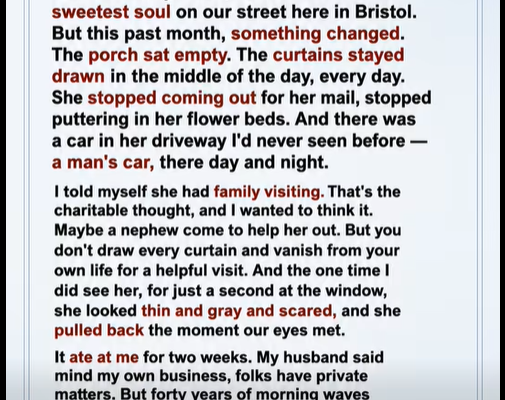
The Forty-Year Wave
Miss Holland edged the curtain back a crack, saw it was me, and instead of hello she whispered,
“Please… don’t let him see you here.”
I froze.
For a moment, neither of us moved.
The curtain trembled between her fingers.
I looked toward the driveway. The man’s car was gone, but the empty space where it had been somehow felt more threatening than the car itself.
“Miss Holland,” I whispered, “are you all right?”
Her eyes filled with tears.
“No.”
That one word hit me harder than if she’d screamed.
I stepped closer to the window.
“Can you unlock the door?”
She shook her head.
“He has a key.”
“Who?”
She looked over her shoulder before answering.
“My son.”
I knew Miss Holland had a son. Everyone on the street did. His name was Daniel. He’d moved away years ago, and I’d only ever seen him a handful of times.
“He came back three weeks ago,” she whispered. “He told me he was here to take care of me.”
I frowned.
“And he isn’t?”
Her mouth trembled.
“He’s taking care of something.”
“What?”
“My house.”
I didn’t understand.
Then she reached through the tiny opening in the curtain and pushed something toward me.
A folded piece of paper.
I took it.
“Don’t open it here,” she whispered. “Go home. Lock your doors. Read it tonight.”
“Miss Holland, I’m not leaving you here alone.”
“You have to.”
“No.”
She looked straight into my eyes.
“You’ve waved at me every morning for forty years.”
I nodded.
“Then please,” she said, “wave tomorrow.”
The curtain snapped shut.
I stood there, stunned.
Then I heard footsteps inside.
I hurried back across the street.
That evening, I waited until my husband was asleep before unfolding the paper.
There were only six words written on it.
HE WANTS ME DECLARED INCOMPETENT.
Below that was an address.
And underneath:
Please call this woman.
I recognized the name.
It belonged to an attorney in town.
The next morning, I woke before sunrise.
I barely slept.
At exactly seven fifteen, I went to the kitchen window.
Miss Holland’s curtains were still closed.
At seven thirty, nothing.
Seven forty-five.
Nothing.
Then, at eight twelve, the man’s car rolled slowly into her driveway.
I watched him get out.
He was carrying a cardboard box.
He looked across the street.
Straight at my house.
I stepped away from the window.
That was when my husband came into the kitchen.
“You’re getting involved,” he said.
“Yes.”
He sighed.
“You don’t even know what’s happening.”
“I know enough.”
I called the attorney.
Her name was Rebecca Miles.
When I explained who I was and why I was calling, she went completely silent.
Then she said,
“Are you Mrs. Holland’s neighbor?”
“Yes.”
“Does she still have access to her phone?”
“I don’t know.”
“Then listen carefully. Don’t confront the son.”
My stomach tightened.
“Why?”
“Because Mrs. Holland came to see me three weeks ago.”
I sat down.
“What did she tell you?”
Rebecca lowered her voice.
“She said her son was trying to sell the house.”
“Can he do that?”
“Not without her signature.”
“He said she wasn’t competent.”
“He’s been trying to establish that.”
I felt cold.
“Is she?”
“No.”
Rebecca paused.
“She’s eighty-four. She’s forgetful sometimes. She takes longer to remember names. But she is perfectly capable of making her own decisions.”
“Then why hasn’t she stopped him?”
“Because he has been frightening her.”
My hands tightened around the phone.
“How?”
“He told her that if she resisted, he’d put her in a nursing facility and make sure none of her neighbors ever saw her again.”
I looked across the street.
The curtains were still shut.
“Can you help her?”
“I can. But I need evidence.”
“What kind?”
“Anything showing that she’s being isolated or pressured. Witnesses. Messages. Financial records. Anything.”
I thought about the forty years I’d known her.
Then I remembered something.
The morning wave.
Every morning.
Rain or shine.
Even after her husband died.
Even when she had pneumonia.
Even when her hands shook too badly to hold her coffee properly.
She always waved.
And suddenly I understood.
The missing waves weren’t just something I’d noticed.
They were evidence.
I wrote down every morning she had stopped appearing.
My husband checked the dates with me.
Then we started asking neighbors.
Mrs. Patel across the street had noticed the same thing.
The mailman had noticed.
The woman who delivered groceries had noticed.
And then something unexpected happened.
The little boy who lived two houses down said,
“I saw the man take her phone.”
We stared at him.
“When?”
“A few days ago.”
“Are you sure?”
He nodded.
“He told her she wasn’t allowed to talk to anybody.”
That was enough for Rebecca.
She contacted adult protective services.
But before anyone could arrive, the man’s car disappeared again.
I ran across the street.
This time, Miss Holland opened the door.
She was holding a small suitcase.
“I knew you’d come,” she said.
“Where are you going?”
“Somewhere safe.”
Then she grabbed my arm.
“He found the letter.”
My heart stopped.
“What letter?”
“The one I gave you.”
“He knows?”
She nodded.
“He asked me who I gave it to.”
“What did you say?”
She smiled weakly.
“I told him the truth.”
I looked toward the driveway.
“What truth?”
“That I’ve had a neighbor watching over me for forty years.”
Sirens sounded in the distance.
Miss Holland closed her eyes.
For the first time in weeks, her shoulders relaxed.
Her son returned ten minutes later.
He stepped out of the car and stopped when he saw the police.
“What is this?” he demanded.
Nobody answered him immediately.
Rebecca arrived behind the officers.
She walked straight to Miss Holland.
“Are you ready?”
Miss Holland nodded.
Her son began shouting.
He called us liars.
He said his mother was confused.
He said she didn’t know what she was talking about.
Miss Holland listened quietly.
Then she looked at him.
“Daniel.”
He stopped.
“I am old,” she said. “But I am not stupid.”
The street went silent.
“I know what you’ve been doing.”
Daniel’s face changed.
“You’ve been taking my money.”
He opened his mouth.
“You’ve been trying to sell my house.”
“Mom—”
“And you’ve been telling me that nobody would believe me.”
She looked around at all of us.
Then she smiled.
“But you forgot something.”
Daniel stared at her.
“What?”
She pointed toward me.
“I have a neighbor.”
The police took him away that afternoon.
Rebecca later discovered that he’d already emptied several of his mother’s accounts and had signed documents attempting to transfer ownership of the house.
Because Miss Holland had kept copies of important paperwork with Rebecca, he hadn’t gotten far enough to take the property.
A few weeks later, she returned home.
The curtains opened again.
The flowers were watered.
The mailbox was emptied.
And on the first Monday morning after she came back, I stood at my kitchen window.
Seven fifteen.
There she was.
Sitting on her porch.
Coffee in hand.
She lifted it slightly.
Then came the wave.
The same little wave she’d given me for forty years.
I waved back.
A few days later, I crossed the street to visit her.
She was sitting among her flowers.
“You know,” she said, “I almost stopped waving years ago.”
“Why?”
She smiled.
“Your husband once told my husband that you could see my porch from your kitchen window.”
I laughed.
“He did?”
“Oh yes.”
She took a sip of coffee.
“Your husband said you always looked out that window while you drank your morning coffee.”
“I still do.”
“I know.”
She looked toward my house.
“That was why I kept waving.”
I frowned.
“I thought you waved because you were being friendly.”
“I was.”
She smiled.
“But after my husband died, those waves became important.”
“How?”
She looked down at her hands.
“Every morning, I knew somebody would notice if I wasn’t there.”
I felt a lump in my throat.
She continued.
“Most people think a wave is nothing.”
She looked at me.
“But sometimes a wave is somebody saying, ‘I see you.’”
I reached across and squeezed her hand.
She smiled.
“And after forty years, you finally proved it.”
“What?”
“That you really were watching.”
We both laughed.
Then she lifted her coffee.
And gave me another little wave.
I waved back.
And from that morning on, I never took that tiny gesture for granted again.
Because sometimes the smallest things are the ones that save us.
Sometimes it isn’t a detective who notices.
It isn’t a police officer.
It isn’t a lawyer.
Sometimes it’s simply the person across the street who realizes that something is missing.
A light.
A flower being watered.
A mailbox being emptied.
A curtain being opened.
Or one little wave.
And sometimes, noticing that something is gone is the first step toward bringing someone home.