The Fourteen Letters
I never told my wife about Margaret.
Not because I was ashamed.
Not because I didn’t love my wife.
And certainly not because I had spent the last sixty-three years secretly wishing for another life.
It was simply a story I had buried so deeply that, after a while, I convinced myself it belonged to someone else.
Summer of 1962.
I was eighteen.
Margaret was eighteen too.
She worked at the little ice cream shop on Lake Street, the kind of place with red vinyl stools, a chrome counter, and a bell above the door that jingled every time someone came in.
I had a paper route in the mornings and worked at my father’s garage in the afternoons.
Every evening, around seven, I’d walk three blocks out of my way just to buy a chocolate malt.
I didn’t even particularly like chocolate malts.
I liked Margaret.
She had blue eyes and a laugh that made her cover her mouth because she thought it was too loud.
We spent that summer sitting on the hood of my father’s old Ford, talking until the streetlights came on.
We made plans the way eighteen-year-olds do.
We were going to get married.
Buy a little house.
Have two kids.
Maybe move somewhere warmer.
We thought the future was something you could simply decide on.
Then, in September, I enlisted.
The country was changing, and I believed I needed to be part of something bigger than myself.
Margaret cried when I told her.
“How long?” she asked.
“I don’t know.”
“Then write.”
“I will.”
I meant it.
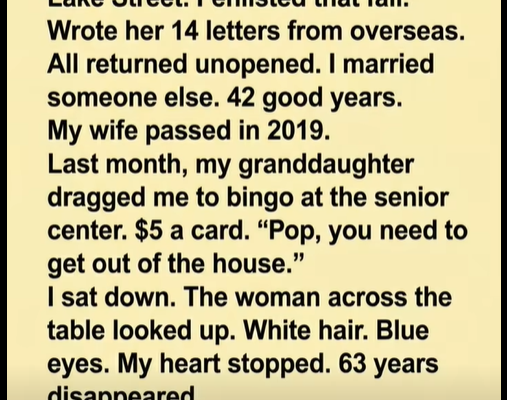
I wrote her fourteen letters.
Fourteen.
I wrote about everything.
The weather.
The food.
The men I served with.
The stupid jokes.
The homesickness.
I wrote her about the night sky and how, sometimes, I would look at the stars and imagine she was looking at the same ones.
I told her I loved her.
Every letter ended the same way.
“Wait for me.”
Every single letter came back.
RETURN TO SENDER.
At first, I thought the mail had made a mistake.
Then I wrote again.
Same thing.
Again.
Returned.
I asked someone back home to check on her.
Her family had moved.
No forwarding address.
Eventually, I stopped writing.
I came home and discovered that Margaret had disappeared from my life as completely as if she’d never existed.
A year later, I met Susan.
She wasn’t Margaret.
That was important.
She wasn’t supposed to be.
Susan was kind, funny, patient, and somehow knew how to make me feel at home.
We married.
Forty-two good years followed.
Not perfect years.
Good ones.
We raised children.
Argued about money.
Took road trips.
Lost parents.
Celebrated birthdays.
Sat beside each other in hospital rooms.
Grew old.
When Susan died in 2019, I thought I had lost the part of me that knew how to imagine tomorrow.
For years afterward, I barely left the house.
Then last month, my granddaughter showed up.
“Pop, you need to get out of the house.”
“I go out.”
“Going to the mailbox doesn’t count.”
“I’m busy.”
“Doing what?”
“Thinking.”
She rolled her eyes.
So she dragged me to bingo at the senior center.
Five dollars a card.
I hated every second of it.
Until I looked across the table.
White hair.
Blue eyes.
My heart stopped.
Sixty-three years disappeared.
“Hello, Robert.”
I couldn’t speak.
My mouth opened, but nothing came out.
“Margaret?”
She smiled.
Not the eighteen-year-old smile I remembered.
Something softer.
Older.
But unmistakably hers.
She slid her bingo card toward me.
On the back was a phone number.
And one sentence.
“I never stopped waiting.”
I stared at those words until they blurred.
“Why?” I finally whispered.
Margaret took a long breath.
“Your letters.”
“What about them?”
“I never received them.”
“I know. They were returned.”
She shook her head.
“No, Robert. They were intercepted.”
I felt the room disappear.
“By who?”
“My father.”
She looked down at her hands.
“He hated the idea of me marrying you. He thought you were going nowhere. When you enlisted, he decided that was his chance to end it.”
I couldn’t breathe.
“He took your letters.”
“All fourteen?”
She nodded.
“I didn’t know you were writing. I thought you’d forgotten me.”
I stared at her.
“Then why didn’t you find me?”
“I tried.”
She told me she had asked around.
Written to my old address.
Even gone to the recruiting office once.
But my family had moved while I was away, and she had eventually accepted what she believed was the truth.
That I had chosen someone else.
“And you?”
“I thought you had chosen someone else.”
We sat there quietly.
Two old people surrounded by strangers playing bingo.
Sixty-three years of misunderstanding sitting between us.
Finally, Margaret laughed softly.
“Isn’t life strange?”
I laughed too.
Then I cried.
Not because I wanted to undo my life.
I didn’t.
Susan had been my wife.
My family was my family.
I would never trade those forty-two years.
But I mourned the eighteen-year-old boy who had spent nights believing Margaret had abandoned him.
And I mourned the eighteen-year-old girl who had spent decades believing the same thing about him.
We met the following Saturday.
Just coffee.
Nothing more.
Then lunch.
Then another coffee.
We talked about everything we’d missed.
She had married once.
Her husband had passed twelve years earlier.
She had children.
I had children.
We showed each other photographs.
She still remembered the little ice cream shop.
“I hated vanilla,” she said.
I smiled.
“You told me you loved it.”
“I wanted you to order it so you’d stay longer.”
I laughed so hard that people at the next table turned around.
For the first time in years, I felt eighteen again.
Not young.
Not foolish.
Just alive.
Before we left that afternoon, Margaret reached into her purse.
She pulled out an old envelope.
Inside were four folded sheets of paper.
My handwriting.
My heart nearly stopped again.
“I found these in my father’s desk after he died,” she said.
There were four letters.
Four of the fourteen.
He had kept them.
I opened the first one with trembling hands.
The date was September 1962.
The first sentence said:
“Margaret, I don’t know if you’ll ever read this, but I need you to know that every mile I travel takes me closer to coming home to you.”
I couldn’t finish.
Margaret placed her hand over mine.
“You came home, Robert.”
I looked at her.
“Just sixty-three years late.”
She smiled.
“Maybe we weren’t late.”
“Then what were we?”
She thought for a moment.
“Survivors.”
That evening, my granddaughter found me sitting at the kitchen table with a smile on my face.
“Pop?”
“Yeah?”
“Did you have fun at bingo?”
I looked at the four old letters beside me.
“Yeah,” I said.
“I did.”
She smiled.
“Are you going again next week?”
I folded the letters carefully and put them in my drawer.
“Absolutely.”
She laughed.
“You finally like bingo?”
I shook my head.
“No.”
I smiled.
“I just like who I found there.”
And for the first time since my wife died, I didn’t feel guilty about being happy.
Because Margaret wasn’t a replacement.
Susan wasn’t a mistake.
And the past wasn’t asking me to choose between them.
It was simply giving me one last gift:
The chance to know that the boy I had been had not been forgotten.
Fourteen letters had crossed an ocean.
Fourteen letters had gone unanswered.
But somehow, after sixty-three years, one sentence finally found its way home.
I never stopped waiting.
And maybe that was enough.