My sister raised me after Mom passed away.
She was nineteen.
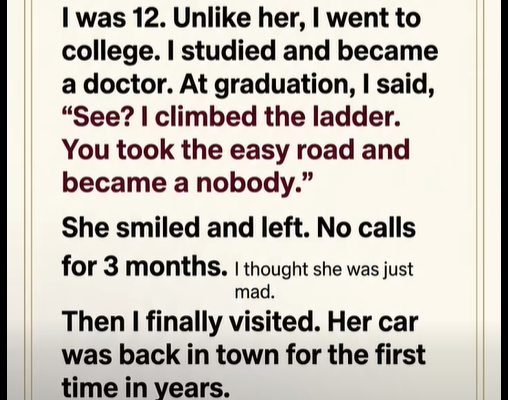
I was twelve.
People like to talk about sacrifice as if it is always some grand, beautiful thing. They imagine someone giving up a dream, making a noble choice, and everyone applauding.
That wasn’t what happened to my sister, Elena.
She simply woke up one morning and realized there was nobody else.
Mom had been sick for months. By the end, our house smelled like medicine and hospital disinfectant. I remember sitting beside her bed, holding her hand while Elena stood in the doorway pretending she wasn’t crying.
Three weeks later, Mom was gone.
Our relatives gathered around us, made casseroles, said things like, “You’ll get through this,” and then slowly returned to their own lives.
Elena didn’t.
She dropped out of her first year of college.
She took a job at a diner in the mornings and cleaned offices at night.
She learned how to pay the electric bill.
She learned how to cook more than three meals.
She learned which teachers would let me stay after school until she finished work.
And somehow, she made sure I never felt like a burden.
Whenever I apologized, she’d ruffle my hair and say, “You’re my little brother. Taking care of you isn’t a burden.”
I didn’t understand what that cost her.
Not then.
I only knew that I wanted something different.
I wanted college.
I wanted a career.
I wanted a life that didn’t involve counting every dollar.
So I studied.
Elena worked.
I got scholarships.
She paid whatever the scholarships didn’t cover.
When I needed a laptop, she sold her old car and told me she’d “been thinking about getting a better one anyway.”
When I got into medical school, she hugged me so tightly I could barely breathe.
“I knew you could do it,” she whispered.
I should have said, “I couldn’t have done it without you.”
Instead, I said, “I’m going to make something of myself.”
She smiled.
“I know.”
Years passed.
I became a doctor.
Elena stayed in our hometown.
She worked at the same little diner for years, eventually becoming the manager. She never complained.
Whenever I came home, she’d ask about my hospital, my patients, my research.
I rarely asked about her.
Somewhere along the way, I started believing the lie that success had made me better than her.
It was subtle at first.
I began correcting the way she spoke.
I told her she should “think bigger.”
I suggested she take an online course or get a business degree.
She always smiled.
“Maybe someday.”
Then came my graduation.
My white coat was pressed perfectly.
My name was printed in gold on my diploma.
My friends and professors filled the auditorium.
Elena sat near the front.
She was wearing the same blue dress she’d worn to my high-school graduation.
After the ceremony, she hugged me.
“I’m so proud of you.”
I looked around at my classmates, their parents, their expensive clothes and polished careers.
Then I looked at Elena.
Something ugly came out of me.
“See?” I said.
She blinked.
“See what?”
“I climbed the ladder.”
I laughed nervously.
“You took the easy road. You stayed here. You became a nobody.”
Her smile disappeared.
For a second, I thought she might slap me.
Instead, she simply nodded.
“You’re right.”
Then she walked away.
I didn’t hear from her for three months.
At first, I was angry.
Then annoyed.
Eventually, I convinced myself she was being dramatic.
One Saturday, I drove home.
I wanted to apologize.
But when I turned onto our old street, I stopped.
Elena’s car was parked outside her house.
I hadn’t seen it in years.
I knocked.
No answer.
The door was unlocked.
“Elena?”
I stepped inside.
And then I froze.
The living room had been transformed.
The walls were covered with photographs.
Photographs of me.
Me at twelve.
Me receiving my scholarship.
Me in college.
Me asleep at a library table.
Me wearing my first white coat.
But beneath every photograph was a handwritten note.
“He almost gave up here.”
“He called me crying after his first anatomy exam.”
“He thought he wasn’t smart enough.”
I walked farther inside.
Then I saw the dining table.
There were stacks of documents.
Bank statements.
College receipts.
Medical school tuition records.
I picked up one.
My hands started shaking.
The money hadn’t come from scholarships alone.
There were years of payments.
Thousands of dollars.
My sister had paid for me.
But that wasn’t the worst part.
I found a folder labeled:
ELENA — FUTURE
Inside were acceptance letters.
College acceptance letters.
From three universities.
All dated twenty years earlier.
She had been accepted to college.
She had wanted to become a teacher.
At the bottom of the folder was a photograph of a young Elena standing outside a university dormitory.
On the back she’d written:
“Maybe someday.”
My knees weakened.
Then I noticed a smaller envelope.
My name was written on it.
I opened it.
Inside was a letter.
“Little brother,
You were right.
You climbed the ladder.
But you forgot who built it.
Every rung was something I gave up.
The first job I wanted.
College.
My friends.
My twenties.
My savings.
The house I wanted.
The life I imagined.
I don’t regret giving those things up.
Not once.
Because I got to watch you become the man Mom wanted you to be.
But when you stood there and called me a nobody, I realized something.
You finally reached the top.
And I was the person you forgot to look back for.
So I decided to stop waiting for you to notice me.
I’m leaving tomorrow.
I’m going back to school.
I’m forty-one years old.
I don’t know if it’s too late.
But I finally want to find out.
Love,
Elena.”
I read it twice.
Then a third time.
My vision blurred.
I sat at the table and cried.
Not because she was leaving.
Because I finally understood.
I hadn’t climbed the ladder alone.
She had carried me up it.
And when I reached the top, I had mistaken her absence for failure.
I found her the next morning at the bus station.
She was sitting beside two suitcases.
When she saw me, she stood.
“What are you doing here?”
I couldn’t speak for a moment.
Then I said the only thing that mattered.
“I’m sorry.”
She looked away.
I stepped closer.
“I thought becoming a doctor made me successful.”
She said nothing.
“I thought your life was smaller because it didn’t look like mine.”
Still nothing.
“And I was wrong.”
Her eyes filled with tears.
I handed her an envelope.
“What is this?”
“Your tuition.”
She shook her head.
“I don’t need your money.”
“I know.”
I swallowed.
“It’s not repayment.”
She looked at me.
“It’s an investment.”
She frowned.
“In what?”
I smiled through my tears.
“In my sister.”
For the first time in months, Elena smiled.
She took the envelope.
Then she hugged me.
And I held on tightly.
Years later, Elena became a teacher.
Not because she needed a title.
Not because she needed to prove anything.
She simply loved children.
On the day she received her teaching certificate, I sat in the front row.
When her name was called, everyone stood.
I stood the fastest.
She looked at me and laughed.
Afterward, I hugged her.
“You did it.”
She shook her head.
“No.”
She pointed at me.
“We did.”
And that time, I understood exactly what she meant.
I had spent my life believing success was about climbing higher than everyone else.
My sister taught me something far more important.
Sometimes the person standing at the bottom of the ladder isn’t the one who failed to climb.
Sometimes they’re the reason you were able to climb at all.
And if you’re lucky enough to realize that before it’s too late, you turn around.
You climb back down.
And you say thank you. :::