Love Doesn’t Pick Favorites
I was ten years old when my mother married a man who already had everything she thought she needed.
A new husband.
A beautiful house.
And, eventually, the child she called her “perfect son.”
I was the daughter she already had.
Somehow, that became the problem.
At first, I tried to be happy for her.
When she told me she was pregnant, I made a little drawing of our family. I drew three people holding hands.
My mother laughed.
“You’re going to be such a good big sister.”
I believed her.
When my baby brother was born, I stood beside his crib and stared at his tiny fingers.
“He’s beautiful,” I whispered.
My mother smiled at him.
Then she looked at me.
“Don’t touch him too much. You’ll wake him.”
That was the first time I realized something had changed.
It wasn’t just that she loved him.
It was that she seemed to have no love left for me.
Every photograph became about him.
Every conversation became about him.
Every celebration became about him.
If he cried, everyone ran.
If I cried, I was told I was being dramatic.
If he got a new toy, my mother said, “He’s just a child.”
If I asked for something, she said, “You’re old enough to understand.”
I was ten.
I wasn’t old enough to understand.
But I was old enough to notice.
My grandmother noticed too.
One afternoon, she found me sitting on the back steps with my knees pulled against my chest.
She sat beside me.
“What’s wrong, sweetheart?”
“Nothing.”
She waited.
Grandma always knew how to wait.
Finally, I whispered, “Mom doesn’t like me anymore.”
Grandma’s face changed.
She took my hand.
“Your mother may be making choices I don’t understand,” she said gently. “But listen to me. Love doesn’t pick favorites.”
I looked at her.
“Then why does she?”
Grandma squeezed my hand.
“Because sometimes adults fail children. That doesn’t mean the child failed the adult.”
A few months later, Grandma took me to live with her.
There wasn’t a dramatic courtroom scene.
No shouting.
No slammed doors.
Just my mother saying she needed “a little more freedom” and Grandma quietly saying, “Then she’ll stay with me.”
I packed one suitcase.
I left my favorite stuffed rabbit behind.
I never saw it again.
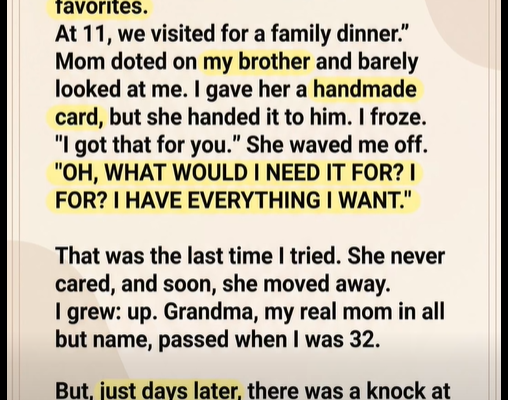
At eleven, I went with Grandma to a family dinner at my mother’s house.
I had spent two days making a card.
It was folded construction paper with crooked flowers glued to the front.
Inside, I had written:
I love you, Mom.
I carried it in my hands the whole drive.
When we arrived, my mother barely looked at me.
She spent the entire evening fussing over my little brother.
“Look at my handsome boy.”
“Did you eat enough?”
“Come sit beside Mommy.”
I stood near the doorway.
Eventually, I walked over and held out the card.
“I made this for you.”
She glanced at it.
Then she handed it to my brother.
“Here. You can have it.”
I froze.
“I got that for you.”
She waved me off.
“Oh, what would I need it for? I have everything I want.”
The room went silent.
Nobody corrected her.
Nobody apologized.
Grandma simply reached for my hand.
We left shortly afterward.
In the car, I stared out the window.
“Grandma?”
“Yes?”
“I’m never making her anything again.”
Grandma’s eyes filled with tears, but she kept driving.
“That’s okay, sweetheart.”
And I never did.
My mother moved away a few years later.
She called occasionally at first.
Then less.
Then not at all.
I grew up with Grandma.
She taught me how to cook.
How to balance a checkbook.
How to plant tomatoes.
How to stand up for myself without becoming cruel.
Most importantly, she taught me that being rejected didn’t make me unworthy of love.
I went to college.
I got a job.
I built a small apartment into a home.
Eventually, I married a kind man who couldn’t understand how anyone could have looked at me and decided I wasn’t worth loving.
When our daughter was born, I held her against my chest and cried.
Not because I was sad.
Because for the first time, I understood how impossible it was for a mother to look at her own child and choose someone else.
Grandma lived long enough to meet my daughter.
She adored her.
Then, when I was thirty-two, Grandma died peacefully in her sleep.
My world collapsed.
She was the person who had raised me.
The person who had chosen me.
The person who had stayed.
Her funeral was small.
I stood beside her casket and held the necklace she had worn almost every day.
“I hope I made you proud,” I whispered.
Three days later, someone knocked on my door.
I wasn’t expecting anyone.
When I opened it, my mother was standing there.
I almost didn’t recognize her.
She looked older.
Smaller.
Tired.
For several seconds, neither of us spoke.
Then she said,
“Can I come in?”
I stepped aside.
She sat at my kitchen table.
Her eyes wandered around the room.
There were photographs everywhere.
My husband.
My daughter.
Grandma.
My mother stared at one photograph for a long time.
“She raised you well,” she whispered.
“She did.”
My mother swallowed.
“I came because I need something.”
I almost laughed.
Of course she did.
“What?”
She looked down at her hands.
“Your brother is in trouble.”
I said nothing.
“He lost his job. His marriage is falling apart. He owes money. A lot of it.”
I waited.
She looked up.
“I thought maybe you could help him.”
There it was.
After twenty-one years of silence, my mother hadn’t come to ask how I was.
She hadn’t come to apologize.
She hadn’t come because she missed me.
She came because her favorite child needed something.
I stood up.
“No.”
She blinked.
“You’re not even going to think about it?”
“I already did.”
“He’s your brother.”
“He was your son.”
She stared at me.
“And I was your daughter.”
Her face went pale.
I continued.
“I spent my entire childhood trying to earn a place in your heart. I made you cards. I waited for you to notice me. I tried to be good enough. And every time you chose him.”
She whispered, “I was young.”
“So was I.”
That silenced her.
She began to cry.
“I made mistakes.”
“Yes.”
“I regret them.”
I nodded.
“But regret isn’t the same as repair.”
She looked at me.
“What do you want me to do?”
“For twenty-one years, I wanted you to want me.”
Her tears rolled down her cheeks.
“And now?”
I touched Grandma’s necklace.
“Now I don’t need you to.”
My mother stared at the necklace.
“Your grandmother hated me.”
“No,” I said. “She didn’t.”
She looked surprised.
“She loved you enough to be disappointed in you.”
I paused.
“But she loved me enough to stay.”
My mother lowered her head.
For a moment, I thought she might finally apologize.
Instead, she whispered,
“Can I see my granddaughter?”
I looked toward the hallway.
My daughter was upstairs.
I thought about the little girl I had once been.
The girl who had carried a handmade card into a room hoping her mother would smile.
The girl who had finally learned that love couldn’t be begged for.
“No,” I said.
My mother nodded slowly.
She stood.
At the door, she turned around.
“I don’t know if you’ll ever forgive me.”
“I already forgave you.”
She looked confused.
“Then why won’t you let me back in?”
“Because forgiveness isn’t permission to hurt me again.”
She stared at me for a long time.
Then she walked away.
I closed the door.
For the first time, I didn’t feel abandoned.
I felt free.
That night, I sat on the porch with Grandma’s necklace in my hand.
My daughter climbed into my lap.
“Mommy?”
“Yes?”
“Are you sad?”
I smiled.
“No, sweetheart.”
She hugged me.
And I held her tighter.
Because Grandma had been right all those years ago.
Love doesn’t pick favorites.
Real love stays.
Real love notices.
Real love doesn’t make a child compete for a place in her own mother’s heart.
And sometimes, the family you are born into isn’t the family that saves you.
Sometimes, the person who saves you is the one who simply looks at you and says:
“You’re mine. And I’m not leaving.”