The Days I Marked Her Absent
I was the teacher who marked Elena absent and moved on.
She was nine years old.
Twenty-three days absent in one semester.
I remember the number because I wrote it in red ink at the top of her attendance sheet and circled it twice.
Twenty-three.
Her mother always sent a note.
Family trouble.
That was all it ever said.
No explanation. No doctor’s note. No details.
Just Family trouble.
At first, I accepted it.
Children missed school for all kinds of reasons. Parents lost jobs. Families moved between relatives. Someone got sick. Sometimes life simply became too heavy for a child to carry and school had to wait.
But Elena was different.
When she was in class, she was almost painfully quiet.
She sat near the window in the third row, always with her hands folded neatly on her desk.
She was a good student, too.
Not brilliant.
Not the kind who raised her hand every five minutes.
Just careful.
Her handwriting was tiny and precise. She erased until there wasn’t a trace of a mistake. If another student dropped a pencil, Elena would flinch before anyone else even turned around.
I noticed that.
I noticed other things, too.
She always wore long sleeves, even when the classroom became hot.
She stopped smiling whenever someone mentioned her mother’s boyfriend.
And one afternoon, while I was handing back math papers, Elena glanced toward the classroom door.
Her mother’s boyfriend was standing outside.
He wasn’t supposed to be there.
He was tall, broad-shouldered, and had a way of staring that made the room feel smaller.
Elena’s pencil slipped from her fingers.
It rolled onto the floor.
She didn’t pick it up.
I did.
“Are you okay?” I whispered.
She nodded quickly.
Too quickly.
“Yes, ma’am.”
Her eyes stayed on the door.
I wanted to ask more.
I wanted to walk her to the counselor.
I wanted to call someone.
Instead, I told myself the same thing adults tell themselves when they’re afraid of being wrong.
I need proof.
So I watched.
And because I was watching instead of acting, I began noticing more.
A bruise beneath her sleeve.
A split lip that disappeared behind a scarf the following day.
The way she sometimes fell asleep during reading time.
The way she became terrified whenever the dismissal bell rang.
One afternoon, Elena stayed behind after everyone else had gone.
She stood beside my desk with her backpack hanging from one shoulder.
“Can I ask you something?”
“Of course.”
She looked toward the hallway.
“Do you think bad things happen because people deserve them?”
The question caught me completely off guard.
“No,” I said.
She stared at the floor.
“Then why doesn’t anybody stop them?”
I should have understood what she was asking.
I should have stopped everything.
Instead, I gave her the answer adults give children when they don’t know what else to say.
“Sometimes grown-ups need more information before they can help.”
She nodded.
“Okay.”
Then she left.
That sentence has followed me for seven years.
Sometimes grown-ups need more information.
What a cowardly thing to tell a nine-year-old who was asking for help without knowing how to say the word.
A week later, I went to the principal.
I showed him the attendance record.
The notes.
My concerns.
He barely looked at the paperwork.
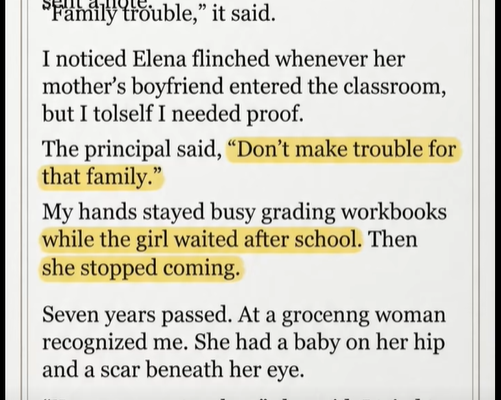
“Don’t make trouble for that family,” he said.
“Sir, I’m concerned about Elena.”
“Her mother has always been cooperative.”
“She has bruises.”
“Children bruise themselves.”
“She flinches when her mother’s boyfriend comes around.”
“You’re making assumptions.”
I stared at him.
He leaned back in his chair.
“Unless you have proof, let the counselor handle it.”
So I went back to my classroom.
I marked papers.
I taught fractions.
I supervised recess.
I wrote comments on report cards.
And Elena kept disappearing.
Then one Monday morning, her desk was empty.
Tuesday, empty.
Wednesday.
Thursday.
Friday.
The following Monday, her mother called.
“Family trouble.”
That was the last note.
Elena never came back.
I told myself someone else would help her.
The counselor.
The principal.
Child services.
A relative.
Someone.
Seven years passed.
I became a different teacher.
I changed schools.
I got married.
Had children.
Moved twice.
But every September, when I filled out attendance sheets, I still remembered the number.
Twenty-three.
Then twenty-four.
Twenty-five.
I never knew the final count.
Until one Saturday afternoon, I was standing in a grocery store deciding between two brands of coffee when a woman beside me said my name.
“Mrs. Harris?”
I turned.
She was holding a baby on her hip.
For a second, I didn’t recognize her.
Then I saw the eyes.
Those careful, watchful eyes.
The little girl from the third row was standing in front of me, grown into a woman.
“Elena?”
She smiled.
It wasn’t a happy smile.
It was the kind people use when they’ve carried something for too long.
“You were my teacher.”
“I remember you.”
She looked down at the baby.
“My daughter.”
The baby was asleep against her shoulder.
Then I noticed the scar beneath Elena’s eye.
A thin white line running from the corner toward her cheek.
My stomach tightened.
“What happened?”
She touched it.
“That?”
I nodded.
She looked at me for several seconds.
Then she asked the question I had spent seven years avoiding.
“Why did you let me disappear?”
I couldn’t speak.
The grocery store suddenly felt unbearably loud.
Carts rolled past us.
A child laughed somewhere near the bakery.
A freezer hummed.
But all I could hear was Elena’s voice.
“I waited for you.”
My eyes filled.
“I thought you needed proof,” I whispered.
She nodded slowly.
“I know.”
“You knew?”
“I heard you talking to the principal.”
I closed my eyes.
“I was nine,” she said. “I didn’t know what I was supposed to do. So I tried to tell you the only way I knew how.”
“I should have protected you.”
“Yes.”
There was no anger in her voice.
That somehow hurt more.
She told me what happened after she stopped coming to school.
Her mother had been afraid of her boyfriend too.
He had controlled the money.
Controlled the house.
Controlled where Elena went and who she talked to.
The bruises I had seen were real.
The “family trouble” notes had been written because her mother was terrified that the school would ask questions.
When Elena finally disappeared from school, her mother took her to an aunt three counties away.
For a while, things got better.
Then they got worse.
Eventually, a neighbor called the authorities after hearing an argument.
The boyfriend was arrested.
Her mother left.
Elena entered foster care.
She spent years moving from house to house.
At sixteen, she ran away.
At nineteen, she found work.
At twenty-two, she had her daughter.
She had built a life.
A difficult one.
But hers.
“I thought about you a lot,” she said.
“I thought you’d hate me.”
“I did.”
The honesty knocked the air from my lungs.
“But I don’t anymore.”
She shifted the baby on her hip.
“I used to think you didn’t care.”
“I cared.”
“I know that now.”
“How?”
“Because I found the note you wrote.”
I frowned.
“What note?”
She smiled faintly.
“The one you gave me the afternoon I stayed after school.”
I remembered nothing.
She continued.
“You wrote, ‘You are worth protecting.'”
I searched my memory.
Then it came back.
I had written those words on a scrap of paper because Elena had asked why bad things happened to people.
I hadn’t given it much thought.
Apparently, she had.
“I kept it,” she said.
“All these years?”
She nodded.
“It was the first time an adult ever told me I was worth protecting.”
I began to cry.
“I wish I’d done more.”
“So do I.”
She reached into her purse and pulled out a folded piece of paper.
The edges were worn.
The ink had faded.
It was my handwriting.
You are worth protecting.
She handed it back to me.
“I don’t need it anymore.”
I stared at the paper.
“Why are you giving it to me?”
“Because maybe you need to remember it too.”
I looked at her daughter.
The little girl opened her eyes.
Elena kissed her forehead.
Then she looked at me.
“There’s something else.”
“What?”
“You weren’t the only adult who noticed.”
I waited.
“The school counselor eventually called my aunt. She kept calling until someone listened. That’s how we got out.”
I swallowed.
“Then why did you come find me?”
Elena looked toward the grocery store entrance.
“Because for years I thought one person’s silence meant nobody cared.”
She paused.
“Now I know silence and caring aren’t the same thing.”
I couldn’t answer.
She smiled gently.
“You were afraid of being wrong.”
“Yes.”
“But I was afraid of being right.”
That sentence broke something inside me.
She picked up her daughter’s little hand and kissed it.
“I just wanted you to know that.”
Then she walked away.
I stood there holding the old note.
For seven years, I had remembered Elena as the little girl who missed twenty-three days of school.
But that wasn’t the truth.
The truth was that she had been present every single day she was able to be.
She had been asking for help without having the language to ask.
And I had been the adult who saw enough to worry but not enough to act.
That night, I went home and pulled out an old box from the back of my closet.
Inside were lesson plans, report cards, photographs, and attendance sheets.
I found Elena’s name.
Twenty-three absences.
I stared at the number for a long time.
Then I wrote beneath it:
She was never absent from my responsibility.
I closed the folder.
The next morning, I went to school early.
A child was sitting alone in the hallway.
She was crying quietly.
I sat beside her.
I didn’t ask for proof.
I didn’t tell her to wait.
I simply said,
“Tell me what happened.”
And this time, I listened.