The Woman in the Blue Honda
My mother died at eighty-nine on a Tuesday morning in November.
She had been sick for months, but somehow that didn’t make the phone call from the nursing home any easier.
For forty-one years, I had called her Mom.
For forty-one years, I had believed I knew the story of my childhood.
I was born in a small town outside Columbus. My mother had raised me alone. My father had died when I was an infant, or at least that was what I had always been told.
Whenever I asked about him, Mom would say the same thing.
“Some stories are better left buried.”
I thought she meant he had abandoned us.
I never pushed.
After the funeral, I spent three weeks cleaning out her house.
Most of it was ordinary.
Old photographs.
Receipts.
Christmas cards.
A drawer full of buttons she’d collected for no reason.
Then I decided to renovate her bedroom.
The wallpaper was nearly fifty years old, faded with age and peeling at the corners. I started stripping it one afternoon, expecting to find nothing but cracked plaster underneath.
Instead, my scraper caught on something.
I pulled.
A small envelope slid from behind the wallpaper and landed on the floor.
My name was written across the front.
Daniel.
Underneath it, in my mother’s handwriting:
Open only after I’m gone.
My hands went cold.
The envelope was sealed.
On the back was a date.
October 14, 1985.
I sat on the floor for several minutes before I opened it.
Inside was a single sheet of paper.
The first sentence made my heart stop.
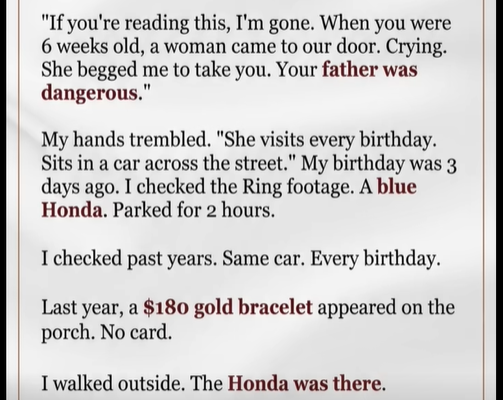
“If you’re reading this, I’m gone.”
I kept reading.
“Daniel, when you were six weeks old, a woman came to our door. She was crying so hard she could barely speak. She begged me to take you.”
I stared at the words.
“She told me your father was dangerous. She said if he found you, he would take you away from her—or worse.”
I stopped breathing for a moment.
Then I read the next paragraph.
“She wasn’t a stranger, Daniel. She was your mother.”
I dropped the letter.
My whole life seemed to tilt sideways.
I picked it up again.
“I know this will hurt you. I am sorry. But I loved you too much to tell you while she was still alive.”
Then came the part that made my hands tremble.
“She never abandoned you.”
“She visits every birthday.”
“She sits in her car across the street because she promised me she would never approach you unless you were old enough to understand.”
“Every year she asks me the same question: Is he happy?”
“Every year I tell her yes.”
I couldn’t read anymore.
I put the letter down and walked outside.
My birthday had been three days earlier.
I had spent it alone.
I checked my doorbell camera.
There was a blue Honda parked across the street.
It had been there for nearly two hours.
I watched the recording.
An older woman sat behind the steering wheel.
She didn’t get out.
She simply stared at my house.
I pulled up the footage from the previous year.
Same car.
Same date.
Same woman.
Then the year before that.
And the year before that.
My mother had written that she visited every birthday.
I searched the recordings going back as far as the camera allowed.
There she was.
Every year.
Always across the street.
Always watching.
Then I remembered something else.
Last year, a gold bracelet had appeared on my porch.
I had assumed it was from my mother.
It wasn’t.
I went into the house and found it in the drawer where I’d kept it.
There was a small engraving on the inside.
D — Always loved.
No card.
No name.
I walked back outside.
The blue Honda was still there.
My heart hammered.
I crossed the street.
The woman rolled down her window.
She looked terrified.
I stood beside the car.
“Are you my mother?”
She covered her mouth.
Tears immediately filled her eyes.
Then she whispered:
“Yes.”
For several seconds, neither of us spoke.
She looked older than I expected.
Her hair was silver.
Her hands shook on the steering wheel.
But there was something unmistakable about her face.
My eyes.
My mother’s eyes.
Except she had my smile.
“Why?” I asked.
She started crying.
“Because I was twenty-one years old and terrified.”
I said nothing.
“Your father wasn’t the man people thought he was,” she continued. “He was violent. He had money, connections, and a temper that could turn a room upside down.”
She wiped her cheeks.
“When you were born, I knew he was going to hurt you someday.”
“So you gave me away?”
“I saved you.”
The words hit me harder than I expected.
She reached into her purse.
“I wanted to take you and run. But I had nowhere to go. No money. No family who could protect us.”
She pulled out an old photograph.
It showed a young woman holding a newborn baby.
Me.
“You were six weeks old.”
She touched the photograph.
“Your grandmother—your mother, as you knew her—was the only person I trusted.”
I looked at her.
“Why didn’t she tell me?”
“Because your father found out I was planning to leave.”
My stomach tightened.
“What happened to him?”
She looked down.
“He died two years later.”
I waited.
“Car accident,” she said quietly. “But I didn’t know whether it was really an accident. I was afraid to come back.”
She told me she’d spent decades watching from a distance.
Every birthday.
Every graduation.
My wedding.
The birth of my daughter.
The first house I bought.
Every milestone.
She had been there.
Never interfering.
Never claiming me.
Just watching.
“Why the bracelet?” I asked.
She smiled through tears.
“It belonged to my mother. I wanted you to have something that came from my side of the family.”
I looked at the woman who had missed forty-one years of my life.
Then I looked back at my house.
“My mother raised me well,” I said.
“I know.”
“She loved me.”
“I know.”
“She never made me feel unwanted.”
The woman nodded.
“That’s why I chose her.”
That sentence broke something inside me.
I sat beside her.
For the first time in my life, I asked the question I’d never been able to ask my mother.
“What’s your name?”
She smiled.
“Rebecca.”
I repeated it softly.
“Rebecca.”
She nodded.
“My name is Daniel.”
She laughed through her tears.
“I know.”
We sat in silence for a long time.
Eventually, I asked her to come inside.
She hesitated.
“Are you sure?”
I looked at her.
“You’ve been sitting across the street for forty-one years.”
She smiled.
“I suppose I’ve waited long enough.”
Inside, I made coffee.
She walked through the house slowly, touching photographs.
When she saw the picture of my mother holding me on my first birthday, she cried.
“She was a good woman,” Rebecca whispered.
“She was.”
Then Rebecca noticed something on the mantel.
The gold bracelet.
I had placed it there.
She touched it gently.
“She told me she’d keep you safe,” Rebecca said.
“She did.”
“And now?”
I looked at her.
“Now we can figure out the rest.”
Rebecca nodded.
She stayed for three hours.
Then she stayed for dinner.
She came back the next day.
And the day after that.
There was no magical way to make forty-one years disappear.
There were questions.
Anger.
Grief.
Awkward silences.
There were things I wished she’d done differently.
There were things she wished she could change.
But slowly, we began building something.
Not a replacement for the life we’d missed.
Something new.
Six months later, we were sitting together in my mother’s old bedroom.
The wallpaper was gone.
The walls were freshly painted.
I had framed the letter and placed it inside a drawer.
Rebecca looked around.
“Your mother left you a secret,” she said.
I smiled.
“No.”
I took her hand.
“She left me the truth.”
And for the first time, the woman who had spent forty-one birthdays watching me from across the street didn’t have to watch anymore.
She was finally sitting beside me.