My MIL Kicked My Parents Out of My Wedding—Then My Husband Took the Mic
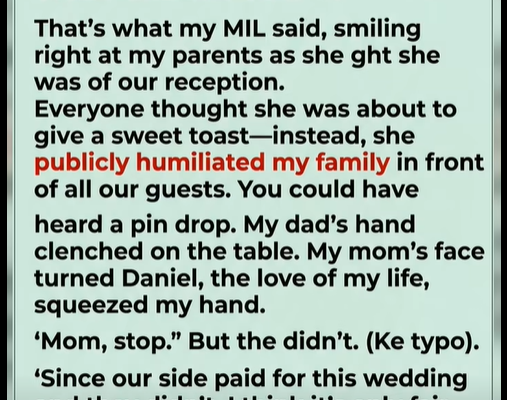
“It’s a shame when people think they can just show up to a wedding they didn’t pay a dime for.”
My mother-in-law, Patricia, said it with a smile.
She was standing at the center of our wedding reception, holding a microphone in one hand and a champagne glass in the other.
And she was looking directly at my parents.
For a second, nobody understood what she’d said.
Then the room went completely silent.
My father slowly lowered his fork.
My mother’s smile disappeared.
And beside me, Daniel—the man I’d just married—squeezed my hand.
“Mom,” he whispered.
Patricia didn’t even look at him.
“Since our side paid for this wedding,” she continued, “and their side didn’t contribute, I think it’s only fair that they leave.”
My heart stopped.
She pointed toward my parents.
“You heard me. This reception was paid for by our family. They shouldn’t be taking advantage of our generosity.”
I couldn’t move.
My parents hadn’t paid for the wedding.
That was true.
But not because they didn’t want to.
They had offered.
My father had even insisted on helping with the venue.
But six months before the wedding, his small construction business had taken a devastating hit when a major contract fell through.
He and Mom were already struggling to keep employees paid.
I’d told them not to worry about the wedding.
Daniel and I would handle what we could.
Patricia had then dramatically announced that she would “take care of everything.”
And she had.
At least, that’s what everyone believed.
What Patricia conveniently never mentioned was that she had offered to pay only after finding out exactly how much my parents could afford.
She wanted the wedding to be “her family’s event.”
I had ignored it because I didn’t want conflict.
That was my mistake.
My father finally stood.
“Patricia,” he said quietly, “if you want us to leave, we’ll leave.”
My mother touched his arm.
But before they could take another step, Daniel stood too.
“No.”
One word.
Loud enough that everyone heard it.
Patricia stared at him.
“What did you say?”
“I said no.”
Daniel took the microphone from her hand.
“You are not throwing my wife’s parents out of our wedding.”
Patricia laughed nervously.
“Daniel, don’t embarrass yourself. Your father and I paid for—”
“No,” he interrupted.
“You paid for some of the wedding.”
She froze.
Daniel turned toward the guests.
“And I think everyone deserves to know the truth.”
I grabbed his arm.
“Daniel…”
He looked at me.
“It’s okay.”
Then he turned back toward the room.
“My mother has spent months telling everyone that her family paid for this entire wedding.”
He paused.
“They didn’t.”
A murmur went through the room.
Daniel continued.
“My wife and I paid for the venue deposit, photographer, flowers, invitations, and most of the vendors.”
Patricia’s face tightened.
“My parents paid for the catering.”
Then he looked directly at my parents.
“And my wife’s parents paid for something much more important.”
My father looked confused.
Daniel smiled sadly.
“They spent the last year helping us whenever we needed it.”
He started listing things.
When my car broke down, my father drove three hours to fix it.
When Daniel lost a month of work, my mother quietly sent us grocery money.
When we moved apartments, my parents spent an entire weekend helping us pack.
When I was sick, my mother sat beside my bed.
None of those things had come with receipts.
None had been announced at family dinners.
But they had mattered.
Daniel looked at his mother.
“So if we’re counting contributions, Mom, let’s count everything.”
Patricia’s mouth opened.
Nothing came out.
Then she said the one thing that made the entire room turn against her.
“Well, none of that matters tonight.”
Daniel shook his head.
“Actually, it matters more than tonight.”
He put the microphone down.
Then he walked over to my parents.
“Please stay.”
My mother began crying.
My father looked away, trying to hide his own tears.
I finally broke down too.
I hugged them both.
And then something unexpected happened.
Daniel’s father stood.
He walked over to Patricia.
“Enough,” he said.
She stared at him.
“You’re making a fool of yourself.”
“But—”
“No.”
He looked at my parents.
“You’re welcome here.”
Then he turned toward the guests.
“And for the record, I didn’t know Patricia was planning this.”
Patricia’s face went white.
The reception continued.
It wasn’t perfect anymore.
But somehow, it became more honest.
My parents stayed.
They danced.
My father even danced with me.
And later that night, Daniel pulled me aside.
“I should have stopped this sooner,” he said.
“You couldn’t have known.”
“I knew enough.”
He took my hands.
“I love you. And your parents are family now. Nobody gets to humiliate them—not even my mother.”
I kissed him.
For the first time that night, I felt like I could breathe.
But the story didn’t end at the wedding.
The next morning, Patricia called Daniel.
She demanded an apology.
He refused.
Then she called me.
“You embarrassed me in front of everyone.”
I almost laughed.
“Patricia, you humiliated my parents at my wedding.”
“They didn’t contribute!”
“They contributed their love, their time, their support, and everything they could afford.”
“They didn’t pay.”
“No,” I said calmly.
“They didn’t. But apparently you think money is the only thing that makes someone family.”
She went silent.
Then she said, “You’ll regret choosing them over us.”
I looked at Daniel sitting across the room.
“I didn’t choose them over you.”
I paused.
“I chose respect.”
She hung up.
For months afterward, things were uncomfortable.
Patricia stopped speaking to us.
She told relatives that Daniel had “turned against his own mother.”
Some believed her.
Others didn’t.
But eventually, the truth spread.
And something changed.
People stopped treating my parents like guests who needed to prove they belonged.
Because they didn’t.
They were my parents.
They had been there long before the wedding.
And they would be there long after the flowers disappeared, the cake was eaten, and the photographs faded.
A year later, Daniel and I renewed our vows in our backyard.
There was no fancy venue.
No expensive decorations.
No competing families.
Just the people we loved.
My father gave a short speech.
My mother cried through it.
And Daniel raised his glass.
“To the people who taught us that family isn’t measured by what you pay for.”
Everyone applauded.
I looked across the table at Patricia.
She had been invited.
She came quietly.
And she didn’t give a speech.
That was probably the greatest gift she could have given us.
Because sometimes the most important lesson isn’t learning who paid for the celebration.
It’s learning who made your life worth celebrating in the first place.