The Letters Roy Sent From Vietnam
Cleaning out the family house in Sioux Falls after Mom’s passing, I found the hatbox where I knew I would: top shelf of her closet, behind the quilts.
Every woman of her generation had one.
Photographs. Funeral cards. My baby shoes wrapped in tissue. A dried corsage from somebody’s wedding. Christmas cards with handwriting that had faded almost to nothing.
I sat on Mom’s bed and went through it slowly, letting myself cry.
At the bottom, underneath a stack of old Christmas cards, was a bundle of letters tied with blue ribbon.
Airmail envelopes.
All addressed to Mom in a strong, slanted hand.
I smiled when I saw the dates.
Dad’s letters from Vietnam.
Everybody knew Dad wrote to her from Vietnam.
He had always told the story that way.
He’d been twenty-two when he enlisted. Mom was twenty. They had been married less than a year. Dad used to say the letters were the only thing that kept him sane overseas.
I untied the ribbon expecting to find the familiar story of my parents’ young marriage.
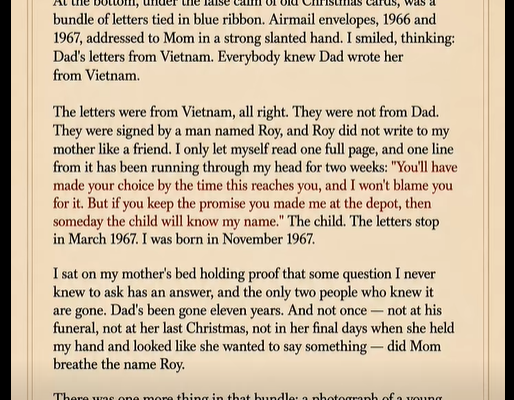
The letters were from Vietnam, all right.
They were not from Dad.
They were signed by a man named Roy.
And Roy did not write to my mother like a friend.
I read one letter.
Then another.
I couldn’t breathe properly by the third.
One sentence from the first letter kept repeating in my head.
“You’ll have made your choice by the time this reaches you, and I won’t blame you for it. But if you keep the promise you made me at the depot, then someday the child will know my name.”
The child.
I was born in November 1967.
The letters stopped in March.
I sat on my mother’s bed holding proof that some question I had never known to ask had an answer.
And the only two people who knew it were gone.
Dad had been dead eleven years.
Mom had died three weeks earlier.
And not once—not at Dad’s funeral, not at her last Christmas, not during those final days when she held my hand and looked at me like she wanted to say something—had Mom ever breathed the name Roy.
There was one more thing in the bundle.
A photograph.
A young soldier stood beside a military transport truck. He was handsome in the awkward way young men often are—too serious for the camera, trying to look older than he was.
On the back, in Mom’s handwriting, were three words:
Roy Whitaker. Nebraska.
Then a town.
My grandson helped me search the name.
There were three Whitakers in that Nebraska town.
One was too old.
One was too young.
The third was a man named Thomas Whitaker, seventy-eight years old.
His younger brother, according to the obituary we found online, had been named Roy.
My hands went cold.
Monday morning, I put the letters in my tote bag, told my husband everything over breakfast, and we backed out of the driveway pointed west.
We didn’t tell anyone where we were going.
I wasn’t even sure what I hoped to find.
Maybe an old house.
Maybe an empty lot.
Maybe nothing.
We drove nearly five hours.
When we finally reached the town, it was smaller than I expected. One main street. A grain elevator. A diner. A church with a white steeple.
The address we’d found belonged to a modest ranch house with a red mailbox.
I sat in the passenger seat for almost ten minutes.
“What if he’s not there?” my husband asked.
“Then I suppose we turn around.”
“And if he is?”
I looked at the house.
“Then I finally find out who I am.”
An older man answered the door.
He had white hair, suspenders, and the kind of face that seemed carved by decades of wind and sun.
“Mr. Whitaker?”
“Yes?”
“My name is Elaine.”
He looked at me politely.
Then I said the name.
“Roy.”
His expression changed.
Not dramatically.
Just enough.
His shoulders dropped.
His eyes narrowed.
And for several seconds he said nothing.
Finally he whispered, “Who are you?”
I held up the photograph.
“I think I might be someone you were never supposed to meet.”
He stared at the young man in the picture.
Then at me.
Then back at the picture.
His hand began to shake.
“That’s my brother.”
“I know.”
He opened the door wider.
“Come inside.”
We sat at his kitchen table.
I placed the letters in front of him.
He didn’t touch them.
Instead, he stared at the blue ribbon.
“My mother kept these,” I said.
“Your mother?”
“Mary Anderson.”
He closed his eyes.
When he opened them again, they were wet.
“I haven’t heard that name in sixty years.”
I swallowed.
“Was Roy in love with her?”
Thomas gave a sad little laugh.
“Roy was crazy about her.”
He told me everything.
Roy had met Mom at a bus depot in Sioux Falls in 1965.
Dad was already in her life, but they weren’t married yet.
Roy and Mom had fallen in love.
Then Roy enlisted.
Mom promised she would wait.
But while Roy was overseas, Dad came home from basic training and proposed.
Mom became pregnant.
Roy’s letters became increasingly desperate.
And then, in March 1967, Mom finally wrote him the letter that ended everything.
Thomas didn’t know what she had said.
Roy never showed anyone.
But after receiving it, Roy came home from Vietnam different.
“He stopped talking about her,” Thomas said.
“But he never married?”
Thomas shook his head.
“Never.”
I looked down at my hands.
“Did he know about me?”
Thomas was silent for a long moment.
“Roy believed you were his daughter.”
The room seemed to tilt.
I couldn’t speak.
Thomas continued.
“He used to keep your name in a little notebook.”
“My name?”
He nodded.
“Elaine.”
I started crying.
“How did he know my name?”
Thomas looked toward the window.
“Your mother told him.”
There it was.
The truth I had spent fifty-eight years not knowing I was missing.
My mother had told Roy.
I was his daughter.
But then why had Dad raised me?
Why had Mom stayed silent?
Why had Roy disappeared?
Thomas got up slowly and walked to a cabinet.
He returned with a small wooden box.
“My brother left this with me before he died.”
I opened it.
Inside was a photograph of a little girl.
Maybe four years old.
Me.
I recognized the dress immediately.
Mom had kept that photograph too.
On the back was Roy’s handwriting.
Elaine, 1971. She has Mary’s eyes.
I pressed the photograph to my chest.
Thomas looked at me.
“Roy wanted to find you.”
“Why didn’t he?”
“Because your mother asked him not to.”
I stared at him.
“She asked him?”
“She told him your father loved you. She told him Dad believed you were his daughter. She said if Roy came into your life, it would destroy the only family you had.”
I thought about my father.
The man who taught me to ride a bicycle.
Who sat beside my hospital bed when I had pneumonia.
Who walked me down the aisle.
Who held my first child.
Who cried when my son was born.
The man who had never once made me feel like anything less than his daughter.
I looked at Thomas.
“Did Dad know?”
“I don’t know.”
That was the hardest answer of all.
Because suddenly I realized there were two possibilities.
Either Dad knew and chose to love me anyway.
Or he never knew, and loved me completely without ever needing proof.
Neither possibility made him smaller.
It made him bigger.
Thomas reached into the box again.
“There is one more thing.”
He handed me an envelope.
My name was written on it.
Not Mom’s.
Not Thomas’s.
Mine.
The letter was dated 1998.
I unfolded it with trembling fingers.
Elaine,
If you ever read this, then your mother finally decided you were old enough to know.
I don’t know whether you will hate me.
I don’t know whether you’ll believe me.
But I need you to know that loving you was never a mistake.
Leaving was.
Your mother asked me to stay away because she believed your father was the only father you needed.
I wanted to fight her.
I wanted to come to Sioux Falls and knock on your door.
But every time I imagined doing it, I remembered the promise I made at the depot.
I promised I would not take your life apart just because I wanted a place in it.
So I stayed away.
But I never stopped loving you.
I have watched your life from a distance when I could.
I know you married young.
I know you have two sons.
I know one of them became a teacher.
I know you have a grandson who likes fishing.
I know your favorite flower is yellow roses.
I know these things because knowing them was the only way I could pretend I wasn’t completely absent from your life.
If your mother never tells you, please don’t blame yourself.
You were never the secret.
You were the promise.
—Roy
I couldn’t read anymore.
I put the letter down and covered my face.
My husband reached across the table and took my hand.
Thomas sat quietly.
After several minutes, I finally asked the question that had been burning inside me.
“Why did he never come?”
Thomas looked at me.
“Because he loved you enough to let someone else be your father.”
I cried harder then.
Not because I had lost a father.
But because I realized I had somehow been loved by two fathers my entire life.
One had been there.
One had stayed away.
And both had loved me in the only way they knew how.
Before we left, Thomas gave me the photograph.
“You should have this.”
I shook my head.
“It’s yours.”
He smiled.
“No. Roy kept it for you.”
On the drive home, I barely spoke.
When we reached Sioux Falls, I went straight to Mom’s house.
The house was nearly empty now.
Boxes everywhere.
Bare walls.
Dust where furniture had been.
I walked upstairs one last time.
I went into her bedroom.
And I opened the closet.
The hatbox was still sitting on the shelf.
I took it down.
Underneath the empty space where the letters had been, I found one final envelope taped to the bottom.
Mom’s handwriting.
My name.
I opened it.
There were only four sentences.
My sweet Elaine,
Your father knew before you were born.
He asked me to let him be your father, and he kept that promise every day of his life.
Roy was your beginning, but your father was your home.
I sat on the floor.
For the first time since Mom died, I wasn’t angry with her.
I wasn’t even angry about the secret.
I understood why she had carried it.
Some truths aren’t hidden because people are ashamed.
Sometimes they’re hidden because someone believes the truth might hurt the person they love.
I folded Mom’s letter and placed it beside Roy’s.
Then I took out my phone.
My grandson had been the one who found Thomas.
I called him.
“I found him,” I said.
“Found who?”
“Roy’s brother.”
There was silence.
Then he asked softly, “Did you find out?”
I looked at the two letters in my hands.
“Yes.”
“Are you okay?”
I looked around my mother’s empty bedroom.
At the place where she had kept the secret for nearly sixty years.
“Not exactly.”
I smiled through my tears.
“But I’m going to be.”
That evening, I placed three photographs on my dining room table.
One of Mom.
One of Dad.
One of Roy.
For years, I had thought my story began with two people.
I was wrong.
It began with three.
And somehow, each of them had spent a lifetime trying to make sure I was loved.
Dad gave me a childhood.
Mom gave me the truth.
And Roy gave me a name.
I kept all three.
Because after fifty-eight years, I finally understood something.
A family isn’t always the people whose names appear on your birth certificate.
Sometimes it’s the people who stay.
Sometimes it’s the people who leave.
And sometimes it’s the people who love you so quietly that you don’t discover their place in your story until they’re already gone.
That night, I put Roy’s photograph beside my father’s.
Not in place of him.
Beside him.
And for the first time in my life, I whispered the name I had never known I was allowed to say.
“Goodnight, Dad.”
Then I looked at Roy’s photograph.
“Goodnight, Roy.”
And somehow, saying both felt exactly right.