The Camera He Destroyed
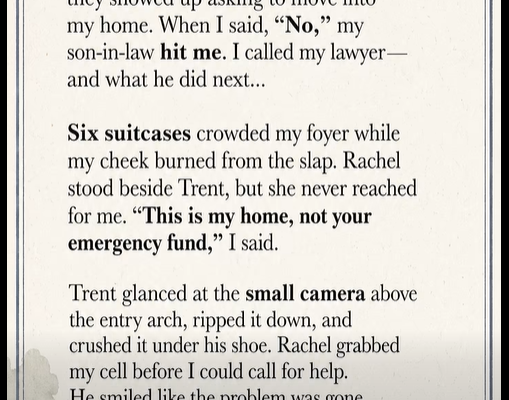
My cheek was still burning when Trent crushed the camera beneath his shoe.
The tiny black pieces scattered across my foyer floor.
For one strange second, nobody moved.
Six suitcases stood behind them, lined up like they had already decided my house belonged to them.
Rachel, my only daughter, stared at the broken camera.
Then she looked at me.
“Mom,” she whispered, “you don’t understand. We have nowhere else to go.”
I touched my cheek.
“I understand perfectly.”
Two weeks earlier, Rachel had owned a beautiful three-bedroom house outside Columbus.
She had sold it for $500,000.
Every dollar had gone to Trent.
His promise was that his “digital business” would turn that money into millions.
He had shown her spreadsheets, cryptocurrency charts, investment projections, and a business plan filled with words I barely understood.
I had warned her.
“Rachel, if this business is so good, why does it need every dollar you have?”
Trent laughed.
“That’s why people stay poor, Linda. They think small.”
Rachel believed him.
So she sold her house.
The closing check went straight into Trent’s business account.
Then, apparently, the money disappeared.
Not slowly.
Not through some unavoidable business failure.
It vanished in eleven days.
And now they were standing in my foyer.
I had told them they could stay at a hotel while they figured things out.
Trent had laughed.
“This is family.”
“No,” I said. “Family doesn’t mean you get to move into my home because you spent half a million dollars irresponsibly.”
His smile disappeared.
Then came the slap.
Rachel didn’t stop him.
That hurt more than the slap itself.
She grabbed my phone when I reached for it.
Trent tore down my security camera.
He thought destroying the evidence would erase what happened.
He was wrong.
Because there was another camera.
One he never noticed.
And before he could reach it, I had already memorized exactly what I needed to do.
I had spent thirty-four years working as a legal secretary.
For twenty of those years, I had worked for the same attorney.
My lawyer was named Harold Bennett.
Harold had taught me one important lesson:
“People who believe they’re clever usually leave the most evidence.”
I walked into my kitchen.
Rachel followed.
“Mom, please. Trent’s under a lot of pressure.”
I turned around.
“He hit me.”
“He was angry.”
“That isn’t an excuse.”
She looked down.
I picked up the landline.
Trent laughed from the foyer.
“You’re calling a lawyer over a family argument?”
“Yes.”
His expression changed when I said Harold’s name.
Harold arrived forty minutes later.
He didn’t come alone.
With him was a police officer.
Trent’s face went pale.
“I didn’t do anything,” he said.
Harold calmly held up his phone.
“That’s interesting.”
Trent stared at him.
Harold continued.
“My client has a security system that automatically uploads footage to a remote server.”
Silence.
Trent looked toward the destroyed camera.
“You mean—”
“Yes,” Harold said. “You destroyed the camera. You didn’t destroy the recording.”
Rachel began crying.
“Mom…”
I couldn’t look at her.
Not yet.
The officer asked Trent to step outside.
He refused.
Harold handed the officer a printed copy of the footage.
The slap.
The phone being taken.
The camera being ripped down.
Everything.
Trent’s confidence vanished.
But Harold wasn’t finished.
He had discovered something else.
While reviewing the financial records Rachel had given me months earlier, Harold noticed something strange.
The $500,000 hadn’t disappeared into Trent’s digital business.
At least not all of it.
More than $300,000 had been transferred into an account under a company name Rachel had never heard of.
The company was controlled by Trent.
But there was another problem.
The account had been opened three days before Rachel sold her house.
Trent had planned everything.
He hadn’t lost the money.
He had moved it.
Harold subpoenaed the records.
What came back was devastating.
Trent had purchased a luxury apartment in another state.
He had bought an expensive car.
He had paid off credit cards.
And he had transferred more than $100,000 to another woman.
Rachel stared at the documents as though she were reading the story of a stranger.
“I trusted him,” she whispered.
I finally looked at her.
“I know.”
She covered her face.
“I ruined everything.”
“No,” I said quietly. “He did.”
The investigation moved quickly after that.
Trent was charged with assault and several counts related to financial fraud.
Rachel wasn’t charged.
She had genuinely believed the money was going into a business.
But legally, the money was still complicated.
Recovering it would take time.
And there was no guarantee we’d recover every dollar.
For the first few weeks, Rachel stayed in a small apartment.
Not my house.
That was important.
I loved my daughter.
But love didn’t mean surrendering boundaries.
One evening, she came to my porch.
“I understand now,” she said.
I didn’t answer.
She continued.
“I thought Mom would always rescue me.”
I looked at her.
“And I thought being your mother meant I had to.”
She started crying.
I hugged her.
But I didn’t invite her inside.
Months passed.
Harold eventually recovered a significant portion of the money through court proceedings.
Not all of it.
But enough for Rachel to rebuild her life.
Trent’s business disappeared.
So did his expensive lifestyle.
Rachel divorced him.
She found a modest job and rented a small townhouse.
And slowly, painfully, she rebuilt herself.
One Saturday morning, she came over carrying groceries.
“I bought too much,” she said.
I smiled.
“That’s a first.”
She laughed.
Then she looked toward the doorway.
The little camera had been replaced.
A new one sat above the arch.
She nodded toward it.
“Good.”
“Good?”
“Yes.”
She smiled sadly.
“Keep the camera.”
I raised an eyebrow.
She took a breath.
“After everything that happened, I think everybody deserves to know that someone is watching the door.”
I hugged my daughter.
But this time, there was something different between us.
Trust wasn’t automatic anymore.
It had to be rebuilt.
And it was.
Slowly.
One honest conversation at a time.
One boundary at a time.
One day at a time.
Trent had thought destroying the camera would make his actions disappear.
Instead, he had taught me something I would never forget:
You don’t need to be cruel to protect yourself. You just need to stop confusing forgiveness with permission.
And sometimes, the strongest thing a mother can say to her own child is:
“I love you. But you cannot destroy my life to repair yours.”