My Neighbor Cut Down My 40-Year-Old Oak Tree While I Was On Vacation….
He said it was “dropping leaves in his pool.”
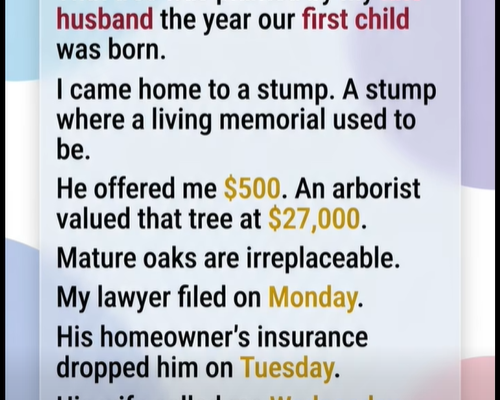
I came home to a stump.
A stump where a living memorial used to stand.
And that was the moment I decided this wasn’t going to be about leaves anymore.
The oak stood near the property line between our two houses, though it was completely on my property. My late husband, Daniel, had planted it forty years ago.
Our first child had been born that spring.
Daniel came home from the hospital holding our newborn daughter and a tiny oak sapling in the back of his truck.
“I want her to grow up with this tree,” he told me.
He dug the hole himself.
Our daughter, Emily, was only a few days old when we stood beside him and watched him place the little tree into the ground.
Over the years, the oak became part of our family.
The children climbed it.
We hung a swing from one of its branches.
Daniel built a small wooden bench underneath it.
Every summer, we had birthday parties beneath its shade.
When Daniel died six years ago, I couldn’t bring myself to move the bench.
I would sit there in the evenings and sometimes talk to him.
It sounds strange, I know.
But grief doesn’t always make sense.
That tree was the one thing in the yard that had been there for almost every important chapter of my life.
Then my neighbor, Rick, moved in next door.
At first, we got along.
Then he installed a large swimming pool directly beside the property line.
Leaves from my oak occasionally fell into it.
He complained.
I offered to pay for reasonable trimming.
He wanted the entire tree removed.
I refused.
“I understand the leaves are annoying,” I told him, “but the tree is healthy and completely on my property.”
He wasn’t happy.
Two weeks before my vacation, he stood at the fence and said:
“You’re going to regret not taking it down.”
I thought he was just angry.
I was wrong.
I left for ten days to visit my daughter and grandchildren in another state.
When I returned, I knew something was wrong before I even opened my front door.
The backyard looked strangely empty.
Then I saw it.
The oak was gone.
Not damaged.
Not trimmed.
Gone.
There was a massive stump where my husband’s tree had stood.
Branches and sections of the trunk had been hauled away.
I stood there frozen.
Then I noticed Rick standing in his backyard.
He actually smiled.
“Finally got rid of that thing,” he said.
I couldn’t believe what I was hearing.
“You cut down my tree?”
“It was causing problems.”
“You had no right.”
He shrugged.
“It’s just a tree.”
Those four words broke something inside me.
Just a tree.
He had no idea what that tree represented.
I asked him who had done it.
He told me he’d hired a landscaping company.
Then he handed me an envelope.
“Five hundred dollars,” he said. “For the trouble.”
I stared at the envelope.
“You think five hundred dollars replaces a forty-year-old oak?”
“It’s compensation.”
I laughed.
Not because anything was funny.
Because I didn’t know what else to do.
The next morning, I called an arborist.
He examined the stump, measured the remaining wood, looked at photographs I had of the tree, and reviewed its condition before it was cut down.
His estimate stopped me cold.
“Based on the tree’s size, species, condition, location and replacement difficulty,” he said, “you’re looking at approximately $27,000 in value.”
I stared at him.
“Twenty-seven thousand?”
“At least. Mature oaks like this are extremely difficult to replace. You can’t simply buy a forty-year-old tree and plant it.”
Then I called my lawyer.
By Monday morning, a formal demand had been sent to Rick.
The claim included the value of the tree, removal costs, property damage, landscaping restoration and other associated expenses.
Rick suddenly stopped smiling.
By Tuesday, his homeowner’s insurance company had become involved.
And apparently, they weren’t pleased.
His wife called me Wednesday evening.
Her voice was shaking.
“Please,” she said. “Can we talk?”
I almost didn’t answer.
But I agreed.
She came over alone.
She looked exhausted.
“I am so sorry,” she said.
I didn’t respond.
She started crying.
“Rick didn’t tell me the whole story.”
“What did he tell you?”
“He said you had abandoned the tree and that you’d agreed he could remove it.”
I stared at her.
“I never said that.”
“I know.”
She wiped her eyes.
“He showed me a text where you said you were willing to discuss trimming it.”
“That is not permission to destroy it.”
“I know.”
Then she told me something I hadn’t expected.
“His insurance company says they may deny the claim because he knowingly had the tree removed without your permission.”
That explained the panic.
“What do you want from me?” I asked.
She looked down.
“Please don’t take everything we have.”
I was quiet for a long time.
Then I said:
“I don’t want your house.”
She looked up.
“I want accountability.”
She nodded through her tears.
“What would make this right?”
I told her the truth.
“I can’t replace the tree. Nobody can. But he can stop pretending this was an accident.”
A few days later, Rick came to my door.
For the first time, he wasn’t angry.
He looked embarrassed.
“I should never have done it,” he said.
“No. You shouldn’t have.”
“I thought it was just a tree.”
I looked past him toward the empty space in my yard.
“It was never just a tree.”
He swallowed.
“I’ll pay whatever the court decides.”
“You should.”
Then he asked:
“Is there anything I can do?”
I thought about it.
“There is.”
I took him into the backyard.
I showed him an old photograph of Daniel planting the oak while I held our newborn daughter.
Rick stared at the picture for a long time.
Then I showed him another photograph from twenty years later.
Our children were teenagers.
The oak towered over them.
Then another.
Daniel sitting on the bench beneath it.
Then another.
My grandchildren playing beneath its branches.
Rick finally lowered his head.
“I didn’t know.”
“You didn’t ask.”
That was all I said.
The case eventually settled.
Rick paid far more than the $500 he’d originally offered.
He also paid to restore the damaged portion of my yard and funded the planting of several new native oak trees.
But I refused to let anyone call them replacements.
They weren’t.
Nothing could replace Daniel’s tree.
Instead, I planted one small oak exactly where the old one had stood.
My granddaughter helped me.
She held the sapling while I packed soil around its roots.
“Grandma,” she asked, “will this one get as big as the old tree?”
“Someday,” I said.
She looked at the empty sky above us.
“Will Grandpa see it?”
I smiled.
“I think he’ll be watching.”
We placed a small plaque beside it.
It read:
PLANTED BY DANIEL
1986–2026
LOVE GROWS WHERE WE LEAVE IT
The new tree was tiny.
Almost fragile.
But as I stood there beside it, I realized something.
My neighbor had taken away the tree.
He hadn’t taken away the memories.
He hadn’t taken away the love.
And he certainly hadn’t taken away the forty years that tree had witnessed.
A living memorial had been destroyed.
But the story behind it was still alive.
And this time, I intended to make sure it stayed that way.
Because some things are worth more than money—not because they are expensive, but because they carry a lifetime inside them.