The Man Who Caught Thieves Was Called a Thief….
For thirty-two years, I worked security at a big department store in Flint.
I started there when I was twenty-eight years old.
By the time I retired, I had gray hair, bad knees, and a reputation for knowing every corner of that building better than most of the managers did.
I caught more shoplifters than I could count.
Teenagers slipping headphones into their jackets.
Adults stuffing cosmetics into purses.
People walking past the registers with merchandise tucked under their coats.
I never enjoyed catching them.
My job wasn’t to embarrass people.
It was to protect the store and keep everybody safe.
I also walked more elderly women to their cars across that dark parking lot than I cared to admit.
Some were nervous.
Some had been robbed before.
Some simply didn’t like walking alone at night.
I’d walk beside them, carrying their bags when they let me.
“Thank you, Earl,” they’d say.
“That’s what they pay me for.”
But the truth was, I would’ve done it anyway.
Over the years, I broke up fights, stopped arguments before they became fights, helped lost children find their parents, and once spent nearly an hour sitting with a frightened little boy whose mother had disappeared into the crowd.
I never once had to raise a hand.
People felt safe when I was inside that store.
Management knew it.
They leaned on me every single day.
Then came the morning that changed everything.
Five hundred dollars disappeared from the cash office.
Not five thousand.
Not fifty thousand.
Five hundred.
The cash office was behind two locked doors.
Only a handful of people had access.
I’d had access for years because part of my job involved escorting cashiers and managers.
But there was something nobody seemed interested in asking.
A young employee had recently been given a key.
He’d been working there less than three months.
I’d warned management twice that he was wandering into areas where he didn’t belong.
They told me I was being paranoid.
The regional manager was in the building that morning.
His name was Mr. Caldwell.
He had never liked me.
I didn’t understand why until much later.
I’d been there long enough to have accumulated a pension that wasn’t insignificant.
And Caldwell had been pushing the company to “reduce legacy costs.”
That was the phrase he used.
I called it getting rid of old people.
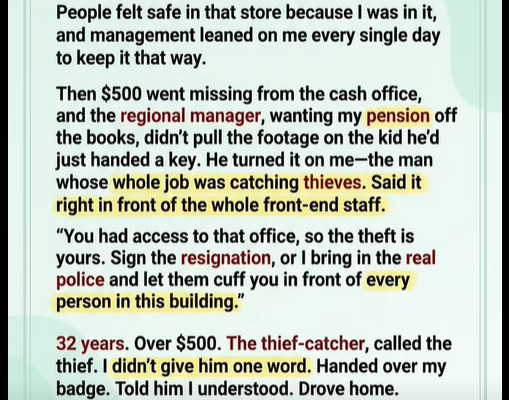
When the $500 went missing, he found his opportunity.
He didn’t pull the security footage.
He didn’t interview everyone with access.
He didn’t even check the electronic key logs.
He walked into the front-end area where about fifteen employees were working.
Then he looked directly at me.
“Earl, come with me.”
I followed him into the office.
He closed the door.
“The cash office is short five hundred dollars.”
“I heard.”
“You had access.”
“So did other people.”
His face hardened.
“I don’t want an argument.”
“Then pull the cameras.”
He stared at me.
For a second, I thought he might actually do it.
Instead, he leaned back in his chair.
“You’ve been here a long time, Earl.”
“Thirty-two years.”
“Exactly.”
He pushed a piece of paper across the desk.
“Sign this. Resignation. We’ll call it voluntary.”
I looked at the paper.
Then I looked at him.
“And if I don’t?”
His voice became quiet.
“I bring in the real police.”
I laughed once because I honestly thought he was joking.
He wasn’t.
Then he said the sentence I’ll remember until the day I die.
“You had access to that office, so the theft is yours. Sign the resignation, or I let them cuff you in front of every person in this building.”
Thirty-two years.
Over five hundred dollars.
The man whose entire career had been about catching thieves was being called a thief.
I didn’t argue.
I didn’t beg.
I didn’t threaten him.
I picked up my security badge.
Set it on his desk.
“I understand.”
Then I walked out.
The front-end employees were watching.
Nobody said anything.
I drove home.
My wife was already gone to work.
I sat at the kitchen table with that resignation paper in my hand.
I didn’t sign it.
I folded it.
Put it in a drawer.
And waited.
Two weeks later, the company held its monthly district meeting.
It was the second Tuesday of the month.
Any employee could stand up and speak.
I put on my good jacket.
The same one I’d worn to my daughter’s wedding.
Then I drove back to that store.
When I walked into the meeting room, conversations stopped.
Some people looked away.
Some looked embarrassed.
A few smiled at me.
The regional manager was standing near the front.
He looked surprised.
“Earl. This meeting is for current employees.”
“I know.”
“Then why are you here?”
I held up the resignation paper.
“I was told I was a thief.”
Nobody moved.
I walked to the microphone.
“I’d like five minutes.”
Caldwell shook his head.
“You don’t work here anymore.”
“Then you shouldn’t be worried about what I have to say.”
A few people looked down to hide their smiles.
Caldwell reluctantly stepped aside.
I placed my hands on the podium.
“I worked here thirty-two years.”
My voice shook at first.
Then it steadied.
“I protected this building. I protected your customers. I protected your employees. I caught people stealing from this company, and every one of you called me when you needed help.”
I looked directly at Caldwell.
“Then five hundred dollars disappeared.”
Silence.
“You had cameras.”
I paused.
“You had key logs.”
Another pause.
“You had employees who had access.”
I held up the resignation paper.
“But you didn’t investigate.”
Caldwell stood.
“Earl—”
I raised my hand.
“No. You gave me five minutes.”
He sat back down.
I reached into my jacket.
And placed a small envelope on the podium.
Inside was a copy of the electronic key report I’d obtained from corporate security after leaving.
The room became completely silent.
“The cash office door was opened at 7:14 that morning.”
I looked around.
“My key wasn’t used.”
I turned the page.
“The new employee’s key was.”
Someone gasped.
Caldwell’s face changed.
I continued.
“Then the camera footage shows him entering the office alone.”
I looked at the employees.
“Three minutes later, he leaves.”
I put down another page.
“The $500 was found in his car two days later.”
Nobody spoke.
Then someone in the back whispered,
“Oh my God.”
Caldwell stood abruptly.
“Where did you get those documents?”
I looked at him.
“From your own security department.”
His mouth opened.
Nothing came out.
Then the store manager, who had been sitting beside him, slowly stood.
“Earl…”
I turned toward her.
“I’m sorry.”
I nodded.
“I know.”
She looked at the floor.
“We should’ve checked.”
“You should have.”
Caldwell tried to interrupt.
But this time, the employees interrupted him.
One cashier stood up.
“He threatened Earl.”
Another said, “He told us Earl stole it.”
A third employee said, “He said Earl was trying to protect his pension.”
Then another voice came from the back.
“He wanted Earl gone.”
The room erupted.
Not shouting.
Something worse.
Truth.
People started telling their stories.
How Caldwell had pressured older employees to retire.
How he’d written people up for minor mistakes.
How he’d threatened workers who complained.
How he’d told supervisors that the store needed “younger energy.”
For the first time in thirty-two years, I wasn’t the one protecting everyone else.
They were protecting me.
Corporate representatives had been sitting quietly at the back of the room.
One of them finally stood.
“Mr. Caldwell, please step outside with us.”
Caldwell looked at me.
There was anger in his face.
But underneath it, there was something else.
Fear.
He walked out.
I never saw him again.
Three months later, corporate called me.
They apologized.
They reinstated my pension.
They paid every dollar I’d been owed.
They even offered me my old job back.
I thanked them.
But I declined.
Thirty-two years was enough.
A week later, I received a letter from the company president.
It said something I’ll never forget.
It wasn’t an apology for the $500.
It was an apology for forgetting who I was.
I framed that letter.
Not because I needed validation.
But because my grandchildren sometimes ask me why I don’t work anymore.
I tell them:
“Because after thirty-two years, I finally caught the biggest thief in the building.”
They laugh.
Then they ask who it was.
I tell them the truth.
“It wasn’t the kid who stole $500.”
“It was the man who thought he could steal a man’s dignity and get away with it.”
And every time I think about that meeting, I remember something else.
I walked into that room expecting to defend my name.
Instead, I discovered that thirty-two years of doing the right thing had left something behind.
People remembered.
The employees remembered.
The customers remembered.
And when the moment came, they stood up.
That was worth more than any pension.
More than any paycheck.
And certainly more than $500.