The Yellow Room….
The radiator in the corner of room two hundred fourteen had a persistent, rhythmic knock that I had spent three days trying to ignore. It was an old iron thing, spitting out dry heat that smelled faintly of scorched dust and hospital floor wax. I sat propped up against four stiff pillows, my knees pulled up under a scratchy flannel blanket that did nothing to stop the chill in my bones.
The doctor told me on Tuesday that my lungs were tired, which was just a polite way of saying the clock had run down. My chest felt hollow, like a dried-out gourd, and the only thing keeping time was the IV drip clicking softly beside my bed.
I kept thinking about wood smoke. My mind liked to wander back to the old coal stove in the winter of nineteen seventy-six, when the drafts used to whistle right through the floorboards of the farmhouse. Back then, my hands were rough from scrubbing laundry in galvanized tubs, and my kitchen always smelled like baking soda and vinegar. I didn’t have visitors much anymore, just the aides who came in to change the sheets and check my charts with quiet, practiced efficiency. They were all young enough to be my grandchildren, moving with a quickness I hadn’t felt in twenty years.
Then the door swung open at seven minutes past eight on a Friday morning.
A nurse stepped inside with a fresh saline bag tucked under her arm.
She had silver threads woven through her dark hair, pulled back into a neat twist at the nape of her neck. She didn’t look up right away, just walked straight to the IV pole and started checking the plastic tubing with familiar, steady fingers. I watched her hands. They were strong hands, square-palmed and capable.
“How are we feeling this morning, Martha?” she asked, her voice dropping into that smooth, practiced register medical people use when they want to sound reassuring.
She reached out to tap the digital readout on my pump, her sleeve sliding back to reveal a silver charm bracelet rattling against her wrist. I froze. My brain kind of stopped working for a second because of the way her left earlobe curved downward, exactly like her grandmother’s used to, or maybe like nobody else’s I had seen in half a century.
“I’m managing,” I said, my voice thin and raspy from the dry air. “The radiator keeps me awake.”
She smiled, a small, polite movement of her lips, and reached for my wrist to check the plastic band that had been clinging to my skin since Tuesday.
Her thumb brushed over my pulse point. I didn’t breathe. I watched her eyes drop from my face down to the faded black ink printed on the white plastic strap.
Her fingers stopped moving entirely. The saline bag slipped an inch against her forearm before she caught it.
“Martha,” she whispered, testing the syllables like she was reading an old tombstone.
She looked up, her dark eyes wide and fixed on my face with an intensity that made the room tilt. Her breath caught in her throat. She stared at the small crescent-shaped scar above my left eyebrow, the one I got when the woodshed door swung back in a November gale twenty years before she was even born.
“It was you,” she said, her voice cracking right down the middle. “The yellow room. Mama always said the woman who saved us was named…”
“…Martha,” I finished for her, the name scraping up out of my dry throat like gravel.
She dropped the saline bag onto the bedside tray with a sharp clatter.
She didn’t care about the sterile protocol or the charts or the beeping monitor behind us. She just leaned over the metal bed rail, her hands shaking as she grabbed both of my paper-thin wrists, pulling me forward just enough that the pillows shifted.
“You’re Martha,” she said again, louder this time, like she had to say it ten times to make it real. “You’re the one from the back door.”
I couldn’t talk. My chin started to tremble, and I just nodded because the dam had broken right behind my eyes.
“Sarah,” she whispered, pressing her forehead against the back of my hand. “My name is Sarah. I’m Clara’s girl.”
The room tilted back on its axis, and suddenly I was standing on my back porch again through a blinding sheet of sleet. It was late December in seventy-six, and the wind was howling off the ridge like a starving animal. I had just finished drying the breakfast skillet when I heard that faint, frantic scratching against the wooden back door.
I pulled the door open, expecting a stray dog or maybe the neighbor’s boy playing a prank. Instead, there was a child standing there in a soaked denim jacket that was three sizes too big for her. She couldn’t have been more than sixteen. Her face was the color of skim milk, and she was hugging her swollen belly with both arms, shivering so hard her teeth were clicking together like dice in a cup.
“Please,” she had whispered, her lips blue and cracked. “Please, just let me sit down.”
I didn’t ask her name. I didn’t ask where her people were or why she was walking the back roads in a blizzard. I just grabbed her frozen hand, dragged her across the threshold, and peeled that soaked coat off her shoulders before she collapsed right there on my braided rug.
We put her in the small spare room upstairs. The one with the butter-yellow paint I had spent three weekends rolling on when we first moved in, hoping for a sunny spot to read my seed catalogs. Clara stayed in that room for four long months. She was terrified of her own shadow, jumping every time a car downshifted on the county road. We spent our afternoons sitting by the wood stove, her shelling beans while I darned socks, neither of us talking much because the silence felt safer than questions.
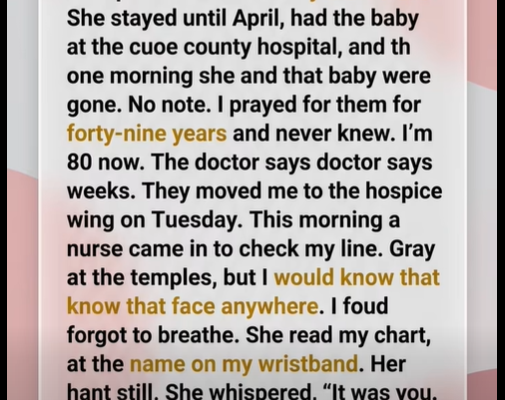
When her time came in April, we didn’t have time to call a proper rig. The snow was turning to greasy grey slush, and I had to hitch the old plow truck just to get us down the lane before she started crying out in the front seat. We made it to Cuoe County Hospital with ten minutes to spare, and she brought a tiny, red-faced baby girl into the world under a flickering fluorescent light.
Three days later, I drove home to pick up a fresh bag of baby clothes and a jar of homemade broth. When I unlocked the back door, the house was dead quiet.
I walked upstairs, pushing open the door to the yellow room. The bed was made, the hospital blankets folded neatly at the foot. Her canvas bag was gone. On the nightstand, resting right under the small brass lamp, was a single dime she must have found in the sofa cushions. There was no note. No thank you. Nothing.
I searched for them for years after that. Every time I drove into town, I looked at every young woman pushing a pram, wondering if that frightened girl had made it out west like she always talked about doing when the winter winds got too high. I prayed for her every night while I washed my supper dishes, asking God to keep her warm wherever she landed. As the decades dragged on and the farmhouse grew too big for my bones, the memory of that yellow room stayed locked in the bottom of my heart like a secret ledger I never balanced.
Now, forty-nine years later, Clara’s baby was standing beside my deathbed with gray at her temples and a stethoscope dangling from her pocket.
“She talked about you every single day of my life,” Sarah said, her voice thick as she wiped her eyes with the sleeve of her scrubs. “Every time we painted a room, it had to be yellow. She said nobody had ever been that good to her when she had nothing left.”
“Is she still…” I couldn’t finish the sentence. My heart was pounding too hard against my ribs.
“She’s seventy-five now,” Sarah said, her smile breaking through her tears like the sun cutting through November fog. “She lives out in Oregon with my brother. She’s got four grandkids running around her kitchen, and every single one of them knows the story of the woman who opened the back door.”
She reached into the deep pocket of her tunic and pulled out a small, dog-eared photograph, pulling off the plastic sleeve with trembling fingers. She laid it across my blanket. It was a polaroid, faded around the edges with a yellowish tint, showing a tiny infant wrapped in a pink flannel blanket sitting right in the middle of my old gingham quilt.
“She took this the day we left the hospital,” Sarah whispered. “She kept it in her Bible for fifty years.”
I stared at the little pink bundle until the edges of the photograph blurred into the white sheets. All those years I spent wondering if I had done enough, if I had missed a sign, if she had frozen in a ditch somewhere out on the highway. And all the while, that girl was carrying my kitchen around in her head like a safe place she could always go back to.
“She never forgot your name,” Sarah said softly, leaning down to press her warm cheek against my shoulder. “She said your kindness saved her life, Martha. She told me to become a nurse so I could pay it back to somebody else.”
The door behind us clicked open, but neither of us turned around. The afternoon sun finally punched through the heavy grey clouds outside, slanting low across the linoleum floor and painting a bright, golden square right at the foot of my bed. It looked just like the light that used to spill through the curtains of the yellow room when the world was young and full of promise.
Sarah didn’t leave when her shift ended at three o’clock. She pulled a metal folding chair right up beside my mattress, sat down, and pulled her phone out of her pocket to dial a number with a western area code.
“Ma?” she said into the receiver, her voice catching as she looked right at me. “You sitting down? You’re never going to guess whose room I walked into this morning.”
I closed my eyes and let out a long, ragged breath, feeling the last cold knot in my chest finally loosen and float away into the hum of the radiator.