Mom Went Into The Hospital For A Knee Replacement On A Tuesday Morning…..
She was seventy-seven years old, nervous but smiling.
“Three hours,” she told me while they were wheeling her toward the operating room. “That’s what the doctor said. Then I’ll be home.”
I squeezed her hand.
“Three hours.”
The surgery was supposed to cost $34,000.
We had already signed the paperwork, confirmed the insurance, spoken with the surgeon, and gone over every detail twice.
It was supposed to be simple.
A routine knee replacement.
At 10:15 a.m., they took her back.
At 12:15, nothing.
At 1:15, still nothing.
At 2:30, I finally walked to the nurses’ station.
“Excuse me. My mother went in at 10:15. Is everything okay?”
The nurse looked at her computer.
“She’s still in surgery.”
“Still?”
The nurse hesitated.
“Sometimes these things take longer.”
I returned to the waiting room.
At 3:05, a nurse finally came through the doors.
She wasn’t smiling.
She walked straight toward me.
“Are you Mrs. Carter’s son?”
“Yes.”
“There was a complication.”
My stomach dropped.
“What kind of complication?”
She glanced toward the floor.
“I think the doctor needs to speak with you.”
A few minutes later, a surgeon came into the waiting room.
He looked exhausted.
And scared.
“Your mother is stable,” he said.
I immediately noticed the word stable.
Not fine.
Not recovering.
Stable.
“What happened?”
He took a breath.
“There was an error.”
“What kind of error?”
He looked at the nurse beside him.
“We began the wrong procedure.”
I stared at him.
“What?”
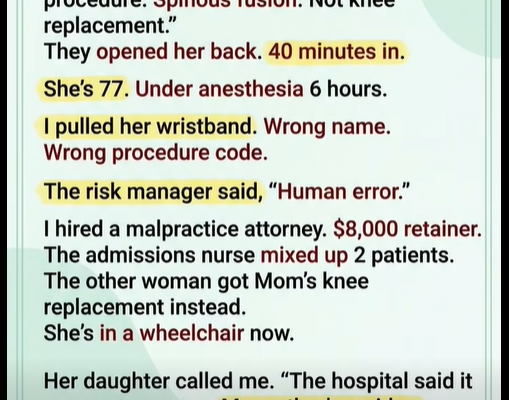
“We started a spinal fusion procedure.”
For several seconds, I didn’t understand the words.
“Mom was here for a knee replacement.”
“I know.”
“You opened her back?”
He nodded.
“How long?”
“Approximately forty minutes.”
My voice became louder.
“You opened my seventy-seven-year-old mother’s back for a surgery she never needed?”
“We recognized the mistake before completing the procedure.”
“That’s supposed to make me feel better?”
Nobody answered.
“How long was she under anesthesia?”
“Approximately six hours.”
Six hours.
My mother had gone into the hospital for a knee replacement.
Instead, they had opened her back.
I immediately demanded to see her.
When I reached the recovery room, she was barely conscious.
Her face was pale.
There were tubes everywhere.
And when I looked beneath the blanket, I saw the bandages across her lower back.
I felt sick.
“Mom?”
Her eyes opened slightly.
“Did they fix my knee?”
I couldn’t speak.
The nurse answered for me.
“Your surgery was changed because of complications.”
Mom closed her eyes.
Something inside me snapped.
I reached for her wrist.
That’s when I noticed the identification bracelet.
I read it once.
Then again.
Then a third time.
The name was wrong.
The procedure code was wrong.
The medical record number didn’t match the paperwork we’d signed.
I looked at the nurse.
“Whose bracelet is this?”
She froze.
“What?”
“This isn’t my mother’s procedure code.”
She took the bracelet and stared at it.
Her face changed.
Within minutes, two administrators arrived.
Then a risk manager.
The risk manager sat across from me.
“We believe this was a human error.”
“Human error?”
“An identification mistake occurred during admissions.”
“You operated on the wrong person.”
“We are conducting an investigation.”
“No. You’re going to tell me exactly what happened.”
She wouldn’t answer.
So I hired a malpractice attorney.
The retainer was $8,000.
It was the best money I ever spent.
Three days later, my attorney called.
“We found something.”
“What?”
“The admissions nurse mixed up two patients.”
I sat down.
“There was another woman scheduled for a knee replacement that morning.”
“Yes.”
“And your mother was scheduled for something else?”
“No. My mother was scheduled for the knee replacement.”
My attorney paused.
“That’s the problem.”
He explained that the other woman had been placed in the wrong pre-op area.
Her chart had been associated with my mother’s room.
Her identification information had been entered incorrectly.
And then the operating-room team received the wrong paperwork.
But there was something worse.
“The other woman received your mother’s knee replacement.”
I couldn’t believe it.
“So they gave Mom’s surgery to another patient?”
“Yes.”
“And Mom received the spinal procedure intended for her?”
“Apparently.”
I stared at the wall.
Two women.
Two charts.
Two surgeries.
One catastrophic mistake.
My mother eventually woke up fully.
But she couldn’t walk normally.
The unnecessary back surgery had caused complications.
She needed months of rehabilitation.
The knee replacement she actually needed had never been completed.
She went home in a wheelchair.
The hospital sent representatives to our house.
They used words like “unfortunate.”
“Unavoidable.”
“Human error.”
I hated those words.
Because there was nothing unavoidable about checking a patient’s name.
Then, two weeks later, the other woman’s daughter called me.
Her voice was trembling.
“They told us it was a name error.”
“What do you mean?”
“My mother’s maiden name is the same as yours.”
I went silent.
“That’s how they explained it.”
I asked her for her mother’s full name.
Then I asked something else.
“Can I see the hospital paperwork?”
There was a long pause.
“Why?”
“Because something doesn’t make sense.”
She agreed.
The next afternoon, we met in the hospital parking lot.
She handed me copies of the documents.
I read them carefully.
Then I saw something that made my blood run cold.
The two women’s names were similar.
But they weren’t identical.
Their dates of birth were different.
Their addresses were different.
Their medical record numbers were different.
And their photographs were completely different.
There was no reasonable way to confuse them if anyone had looked.
I went back inside the hospital.
My attorney had arranged a meeting with the risk manager.
During the meeting, I asked one question.
“Did anyone verify the photographs before surgery?”
The risk manager looked uncomfortable.
“Standard procedure requires multiple identification checks.”
“That’s not what I asked.”
Silence.
“Did anyone look at the patient’s photograph?”
She finally said:
“We’re still investigating.”
I stood up.
“Then let’s investigate together.”
I walked back toward the surgical waiting area.
As I passed a nurses’ station, I noticed a stack of papers on the floor near a trash bin.
Something was lying face-up beneath them.
A photograph.
I bent down.
I picked it up.
And I recognized the woman immediately.
It was the other patient.
The woman who had accidentally received my mother’s knee replacement.
Her photograph had been sitting on the floor.
Face-up.
Beside the paperwork.
I turned it over.
On the back was a patient identification label.
And underneath it was a handwritten note.
“VERIFY BEFORE OR.”
I took a photograph of it.
Then I called my attorney.
“You need to come here.”
“Why?”
“I found the patient’s photo.”
“Where?”
“On the floor outside the surgical area.”
He went quiet.
“Was it face-up?”
“Yes.”
“Don’t touch anything else.”
“I already picked it up.”
“Keep it.”
That photograph changed everything.
The hospital could call it human error.
They could call it a clerical mistake.
They could blame two similar names.
But they couldn’t explain why a patient’s photograph—clearly labeled and specifically marked for verification—had been lying face-up on the floor outside the operating area.
The investigation eventually uncovered more.
There had been no final bedside verification.
The photographs hadn’t been checked.
The wristband wasn’t properly matched against the operative consent.
And the wrong procedure code had been carried into the operating room.
The hospital had multiple opportunities to catch the mistake.
They missed every one.
My mother spent months recovering.
She never became the woman she was before that morning.
She needed assistance walking.
She couldn’t garden the way she used to.
She couldn’t climb stairs without help.
And the knee replacement she went into the hospital for had to be postponed until doctors determined it was safe.
The other patient’s family eventually joined our lawsuit.
Two families.
Two patients.
One hospital.
One terrible mistake.
The settlement was substantial.
But money didn’t undo what happened.
It didn’t give Mom back the months she lost.
It didn’t erase the scar on her back.
And it didn’t give me back the moment when she woke up and asked:
“Did they fix my knee?”
Because every time I remember that question, I remember the photograph on the floor.
The photograph that proved this wasn’t simply a case of two similar names.
It was a chain of failures.
And one thing still bothers me.
The hospital called it a human error.
But humans had checked her chart.
Humans had put on her wristband.
Humans had reviewed the procedure.
Humans had wheeled her into the operating room.
And humans had looked at a seventy-seven-year-old woman before opening her back.
Not one of them stopped to ask the simplest question:
“Are you sure this is the right patient?”