The radio in my old Ford pickup had this habit of cutting out whenever I crossed the county line near the creek bridge, dropping the midday news into a hiss of gray static that always made my teeth itch. I kept driving past the feed store with its yellow sacks of scratch grain stacked against the window and the hardware porch where Harlan and the boys sat on overturned nail kegs watching the traffic crawl by at twenty-five miles an hour.
It was a Tuesday, gray and heavy with the kind of low-slung cloud cover that smells like wet lime and turning pasture, and my hands felt stiff on the wheel the way they always did when I had too much coffee and too little sleep. My name is Gordon, though around the machine shop they just call me by my last name or yell over the shaper when a gear blank comes out an eighth of an inch off center. For twenty-five years I built my life around three things that never changed: the five-thirty whistle at the foundry, the rattle of the copper pipes in the hallway whenever the well pump kicked on, and Eleanor sitting across the kitchen table with her ledger and a yellow legal pad, checking the electric bill down to the nickel.
We had made it to twenty-five years without a foreclosure, without a visit from the sheriff, and without a single Sunday church service missed until her mother took sick back in eighteen.
People in this town don’t talk much about who stays and who leaves because everybody already knows whose granddad drank away the bottomland and whose uncle skipped town with the credit union deposit box. We stayed put. We planted tomatoes in the same corner of the garden every May, tied the heavy vines to cedar stakes I cut myself out behind the woodlot, and watched the dirt dry out into gray cracks by August. I thought that kind of stubborn persistence meant something. I thought if you just kept showing up at the gate at seven in the morning and bringing home your pay envelope without pulling any foolish stunts, the ledger of your life would balance out clean in the end. But last week the phone rang at 4:12 in the morning, right when the air in the house is coldest and the water heater gives that long, metallic ping as it cools down, and the voice on the other end didn’t belong to anybody from around here.
It belonged to a woman whose name I hadn’t said out loud since the winter Obama got sworn in for his second term.
She didn’t waste time with hellos. She just told me the girl was twelve now, that she had my narrow chin and the exact same pale blue mark behind her left ear that looked like a drop of spilled ink, and that the doctor at the clinic in Charleston said the spine surgery couldn’t wait another month. Forty-seven thousand dollars. That was the figure she dropped into the dark bedroom while Eleanor was breathing steady beside me, her face turned toward the wall and her graying hair spread across the pillow like dried bunchgrass. I stood there in my undershirt on the cold linoleum of the hallway with the receiver pressed against my ear until the dial tone started its high, thin buzz, and my knees felt watery the way they did the time I nearly dropped a three-ton stamping die on my boot down at the shop.
I didn’t wake Eleanor right then. I walked back into the bedroom, pulled my heavy flannel shirt over my shoulders, and sat in the dark armchair by the window until the first pale streak of daylight turned the distant ridge of the hills the color of a wet slate shingle.
By evening we were sitting in our favorite booth at the Olive Garden out on the highway near the bypass, the one with the high wooden back that lets you pretend nobody else in the restaurant exists. Eleanor had on her good navy cardigan with the pearl buttons, the one she wears to funerals and the annual bank dinner, and she ordered her chicken alfredo without asking to look at the menu because she hadn’t changed her mind about anything she liked since the first Bush administration. The bill came out to seventy-eight dollars even before the tip, which seemed like an awful lot of money for noodles and garlic bread, but I figured it was our silver anniversary and the girl at the hostess stand had given us two little plastic glasses of sparkling cider with our water. I waited until the waitress walked away with our salad bowls before I touched my water glass, my thumb rubbing the wet condensation in a circle until the glass squeaked. My mouth felt as dry as an old corn husk, and I kept looking down at my hands to make sure my fingers weren’t shaking too hard for her to notice.
I said, “I need to tell you something.”
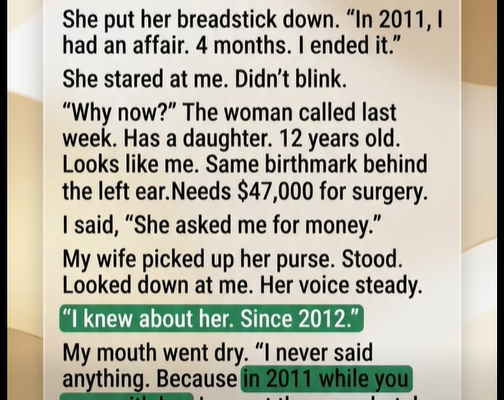
She put her breadstick down on the paper placemat, right beside the little butter knife, and she didn’t rush. She never rushed when she was waiting for me to finish a clumsy sentence about why the truck needed a new transmission or why I stayed late at the shop helping Miller rebuild the lathe.
“In 2011, I had an affair,” I said. My voice sounded thin, like dry grass dragging across a gravel road. “Four months. I ended it.”
She stared at me. She didn’t look down at her lap, she didn’t reach for her napkin, and she didn’t blink. Her eyes were that pale, washed-out blue that looks like pond ice in February, and they stayed locked right on the bridge of my nose.
“Why now?” she asked.
The words came out of her mouth level and even, without a single tremor or a catch in her throat, the way she used to talk to the grain elevator clerk when he tried to short-weight our load by fifty pounds. That was the moment I should have stopped, but the panic of that 4:12 phone call was still buzzing behind my ears like a trapped hornet, and I was terrified of what would happen if I kept the rest of it inside my ribs.
“The woman called last week,” I said, my voice dropping down to a raspy whisper so the people in the next booth wouldn’t hear about the forty-seven thousand dollars. “Is a daughter. Twelve years old. Looks like me. Same birthmark behind the left ear. Needs forty-seven thousand dollars for surgery.”
I stopped there, waiting for the floor to drop out, waiting for her to throw her water glass across the table or start screaming the way my sister did when she found out about her first husband’s gambling debts down in Huntington. Instead, she just picked up her linen napkin, folded it once down the middle with neat, sharp creases, and laid it across the edge of her plate.
“She asked me for money,” I said, leaning in so close I could smell the faint scent of the lavender soap she’d used since we lived in the little rental house behind the lumberyard. “I never said anything. Because in 2011, while you were with her, I was at the same hotel. Different floor. With your…”
My sentence broke right there in the middle of the noise of the dining room, right as a tray of wine glasses rattled against a service station across the room, because my brain finally seized up on the trap I was trying to build to protect myself. I had spent fifteen years carrying the secret of those four months in Charleston like a sack of wet salt on my shoulder, convinced that if the truth ever leaked out it would wash our entire life away down the creek. I remembered the smell of the carpet in that hallway, the yellow plastic bucket the cleaning crew left by the ice machine, and the way the traffic down on Meeting Street sounded like a low roar through the heavy glass of the window. I thought I was the one keeping the secret, the one guarding the vault, the one who held the power of destruction in my own two hands if I ever chose to open my mouth.
Eleanor didn’t yell. She didn’t slam her hand down on the sticky wood of the table or demand to know who else was staying in that brick building off the interstate fifteen years ago when the dogwood trees were just starting to drop their petals. She reached down beside her right foot, lifted her black leather purse with the brass clasp that always stuck if you didn’t pull it straight, and set it on her lap. Then she used both hands to push herself up from the red vinyl bench, her movements so slow and deliberate that the salt shaker didn’t even wobble.
She looked down at me from across the table, her face entirely blank, the way it looked the morning we buried her father out behind the Methodist church when the ground was frozen six inches deep and nobody had anything left to say. Her voice was steady, quiet, and completely level.
“I knew about her. Since 2012.”
She turned around and walked down the carpeted aisle toward the front doors without looking back once, her sensible black shoes making a soft, muffled sound against the floor as she passed the hostess stand where the menus were stacked. I sat there alone in the dark corner of the booth with the smell of melted butter and garlic hanging in the air around me, watching the seventy-eight dollar check curl up slightly where my warm fingers had been resting against the corner of the paper. Through the grease-spotted glass of the front window, I saw the headlights of her old Buick sweep across the wet gravel of the parking lot, lighting up the yellow sign of the state highway before the red tail-lights blinked twice and disappeared into the gray West Virginia night.