Emma was sixteen when her father taught her something she would remember for the rest of her life.
They were sitting in the kitchen one Friday evening, sharing a bowl of popcorn while her mother was upstairs folding laundry.
Emma had been telling him about a friend whose parents were extremely strict.
“They make her explain everything,” Emma said. “Where she is, who she’s with, why she wants to leave…”
Her father smiled.
“Then let’s make things easier for you.”
Emma looked at him.
“How?”
He leaned back in his chair.
“If you ever feel unsafe somewhere, I don’t want you worrying about hurting someone’s feelings. You don’t have to explain yourself. You don’t have to make up a believable story.”
He paused.
“Just text me, ‘My phone is dying.’”
Emma laughed.
“Dad, that’s ridiculous. What if my phone actually is dying?”
“Then I’ll know the difference.”
“How?”
“I won’t care what your battery says. If you send those words, I’m coming.”
Emma’s smile faded.
“You’re serious?”
“Completely.”
“What if it’s midnight?”
“I’ll come.”
“What if you’re working?”
“I’ll leave.”
“What if you’re an hour away?”
“I’ll drive.”
“What if I get embarrassed?”
Her father reached across the table and squeezed her hand.
“Emma, listen to me. You never have to be embarrassed about asking your dad to come get you.”
She nodded.
“Okay.”
He pointed at her phone.
“Say it again.”
Emma rolled her eyes playfully.
“My phone is dying.”
“Good. That’s our code.”
Neither of them knew how important those four words would become.
Several months later, Emma went to a friend’s house party.
Her parents knew where she was and had agreed to pick her up afterward.
At first, everything was fine.
There were a lot of teenagers, loud music, food, and people moving in and out of the house.
Emma stayed close to her friends.
Then she noticed a boy she’d never met.
He started trying to talk to her.
She politely told him she wasn’t interested.
He didn’t stop.
When she moved into another room, he followed.
When she joined her friends outside, he appeared there too.
Emma tried laughing it off.
But eventually, she realized she wasn’t imagining it.
She felt trapped.
She didn’t want to cause a scene.
She didn’t want her friends to think she was overreacting.
And she didn’t know how to get away without making the situation worse.
Then she remembered her father’s promise.
She pulled out her phone.
Her hands were shaking.
She typed:
My phone is dying.
Then she pressed send.
Her father replied almost immediately.
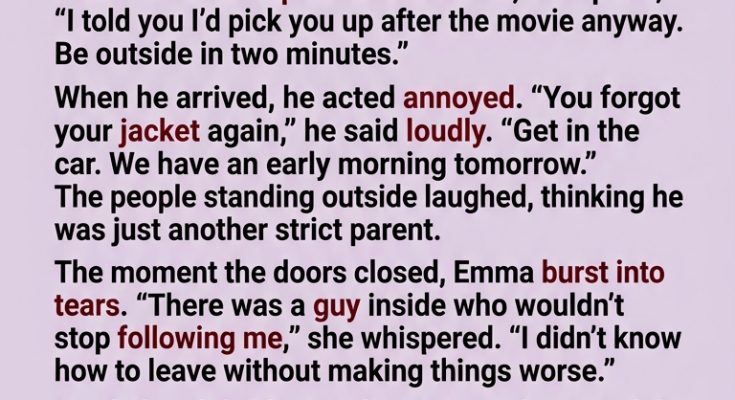
I told you I’d pick you up after the movie anyway. Be outside in two minutes.
Emma stared at the message.
He understood.
He didn’t ask where she was.
He didn’t ask what happened.
He didn’t demand an explanation.
He simply came.
Two minutes later, a familiar car pulled up outside.
Emma’s father stepped out.
He looked around calmly.
Then, loud enough for everyone nearby to hear, he said,
“Emma! You forgot your jacket again.”
Emma blinked.
Her father sighed dramatically.
“Get in the car. We have an early morning tomorrow.”
A few teenagers laughed.
Someone whispered, “Her dad is so strict.”
Emma hurried toward the car.
Her father opened the passenger door.
“Come on.”
She got inside.
He closed the door, walked around to the driver’s side, and started the engine.
For several seconds, neither of them spoke.
Then the doors locked.
The outside world disappeared behind the glass.
Emma’s face crumpled.
Tears rolled down her cheeks.
“There was a guy inside,” she whispered. “He wouldn’t stop following me.”
Her father tightened his grip on the steering wheel.
“Okay.”
“I tried to get away.”
“I know.”
“I didn’t know how to leave without making things worse.”
Her father glanced at her.
“You did exactly the right thing.”
“But I didn’t even tell you what happened.”
“You didn’t need to.”
She wiped her eyes.
“Aren’t you mad?”
“Not at you.”
He reached over and gently squeezed her shoulder.
“Emma, you never have to explain why you need me.”
She looked at him through tears.
“If you call, I’ll come.”
He paused.
“Every single time.”
The next morning, Emma expected questions.
Instead, her father made breakfast.
He didn’t interrogate her.
He didn’t demand every detail.
He simply told her that if she ever wanted to talk, he would listen.
Eventually, Emma told him everything.
Together, they talked about what had happened, how she could trust her instincts, and what she could do if she ever found herself in an uncomfortable situation again.
Her father also reminded her of something important.
“You don’t owe anyone politeness when you’re afraid.”
Emma never forgot those words.
Years passed.
Emma went to college.
She moved to another city.
She started a career.
She fell in love.
Eventually, she became a mother herself.
One afternoon, while cleaning an old drawer, Emma found her father’s original text message from that night.
She stared at it for a long time.
Then she called him.
“Dad?”
“Hey, sweetheart.”
“Do you remember the code word?”
He laughed.
“Of course I do.”
Emma smiled.
“I think I finally understand why you did it.”
“Why?”
“Because you weren’t really teaching me a secret code.”
Her father was quiet.
“You were teaching me that I could come home.”
There was a long silence on the phone.
Then he said softly,
“That was the whole point.”
Emma looked at the photograph of them sitting together in the kitchen years earlier.
“I hope my children always know that too.”
“They will,” her father said. “Because you learned it.”
Emma smiled through tears.
She had forgotten many things from being sixteen.
The music at that party.
The clothes she wore.
The conversations she’d had.
Even some of the faces.
But she never forgot the sound of her father’s voice when he told her:
“If you call, I’ll come. Every single time.”
And that was the greatest gift he had ever given her.
Not a car.
Not money.
Not freedom.
He had given her something much more valuable:
the certainty that home was never more than one phone call away.
Because the best parents aren’t the ones whose children never need them.
They’re the ones who make sure their children are never afraid to call.
Moral: A child who knows they can always call home is never truly alone.