The Retirement I Thought I Had….
For twenty-four years, I worked for the same company.
I had seen managers come and go, survived layoffs, mergers, impossible deadlines, and countless meetings that could have been emails. I had trained younger employees who eventually became supervisors. I had stayed loyal through years when other companies offered more money.
Why?
Because I believed loyalty would eventually give me something valuable in return: security.
At sixty years old, I could finally see retirement on the horizon.
Just four more years.
I had done everything I was supposed to do. I contributed to my 401(k) every paycheck. I avoided expensive vacations. I drove my cars until they practically begged for retirement themselves. My wife and I delayed renovations, skipped luxuries, and told ourselves the sacrifices would be worth it.
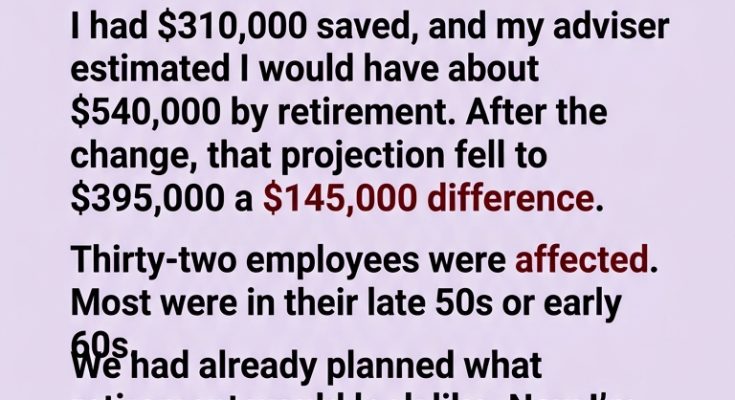
I had approximately $310,000 in my retirement account.
My financial adviser had projected that, with continued contributions, investment growth, and the company’s 401(k) match, I could retire at sixty-four with around $540,000.
It wasn’t a fortune.
But combined with Social Security, careful spending, and a paid-off home, it was enough.
Enough to breathe.
Enough to stop watching the clock.
Enough to finally live without calculating every paycheck.
Then HR called a company-wide meeting.
I still remember sitting there with my coffee, barely paying attention at first.
Then the HR director cleared her throat.
“Due to changing economic conditions, the company has made adjustments to its employee benefits package.”
My stomach tightened.
She continued.
“Beginning next year, the company will significantly reduce its 401(k) matching contribution.”
The room went silent.
At first, I didn’t understand what it meant for me.
That evening, I called my financial adviser.
He ran the numbers twice.
Then he became quiet.
“What is it?” I asked.
He sighed.
“Your previous retirement projection was approximately $540,000.”
“And now?”
“Approximately $395,000.”
I stared at the phone.
“That’s wrong.”
“I checked it twice.”
“$395,000?”
“Yes.”
The company decision had potentially changed my projected retirement savings by roughly $145,000.
One hundred forty-five thousand dollars.
Gone—not from my account, but from the future I had spent decades building toward.
The next morning, I discovered I wasn’t alone.
Thirty-two employees were affected.
Most of us were in our late fifties or early sixties.
People who had already planned their retirement dates.
One woman had planned to move closer to her grandchildren.
Another employee had promised his wife they would finally travel after decades of working opposite schedules.
One man had already started preparing his replacement because he planned to retire in three years.
We weren’t young employees with thirty years to recover.
We were at the finish line.
Or at least, we thought we were.
A few of us approached HR together.
We asked whether there would be exceptions for long-term employees.
“No,” they said.
We asked whether employees close to retirement could keep the old match temporarily.
“No.”
We asked whether the company had considered how severely this would affect older workers.
“The decision applies equally to all eligible employees.”
Then someone asked the question we had all been thinking.
“Can the company legally do this?”
The HR representative pulled out a document.
“The benefits plan contains language stating that the company reserves the right to amend or modify benefits.”
The document was from 2021.
Technically, they may have been right. In general, employers can change future employer contributions in many defined-contribution plans, depending on the plan terms; benefits already accrued generally cannot simply be taken away.
But legality wasn’t the only question.
I looked around that room at people who had spent decades building their lives around promises, projections, and compensation packages.
And I thought:
Just because you have the right to do something doesn’t automatically make it right.
The company had spent years promoting its retirement benefits during recruitment.
They had encouraged us to stay.
They had told us to invest in our future.
And we did.
Now, when many of us were closest to retirement and had the least time to recover, the rules changed.
That night, my wife asked me what I was going to do.
I didn’t answer immediately.
Finally, I said:
“I might have to work until seventy-one.”
She looked at me.
“You were supposed to retire at sixty-four.”
“I know.”
For the first time in twenty-four years, I started looking at my employer differently.
I had always believed loyalty was a two-way street.
But maybe I had confused loyalty with convenience.
The company appreciated us when we were useful.
They valued our experience when they needed it.
But when protecting the bottom line required a sacrifice, retirement dreams were apparently negotiable.
Mine included.
Over the next few weeks, the thirty-two affected employees began talking.
Not angrily at first.
Carefully.
We requested copies of the official plan documents.
We compared the previous match with the new one.
We asked questions about when the decision had been made and whether employees had received proper notice.
We considered speaking with an employment or ERISA attorney—not necessarily to sue, but to understand our rights.
Because sometimes accepting something quietly is exactly what organizations expect people to do.
And sometimes asking questions is the only power ordinary employees have left.
I still don’t know whether I will retire at sixty-four.
Maybe I’ll work longer.
Maybe I’ll increase my own contributions.
Maybe I’ll find another job for a few years.
Maybe the company will reconsider if enough employees speak up.
But one thing changed permanently.
I stopped thinking of retirement as a gift my employer was helping me earn.
It’s my responsibility.
My future.
My security.
And from now on, I will never build my entire retirement plan around the assumption that a company will remain loyal simply because I was.
Because companies can change policies.
They can change leadership.
They can change benefits.
They can change promises.
But I can’t easily get back the years I spent believing the future was guaranteed.