I Bought a Home, But Somehow I Needed Permission to Live in It….
When I bought my townhouse, I thought the biggest expense would be the mortgage.
I was wrong.
I had spent years saving for that house.
Years of skipping vacations, working overtime, eating at home, and watching my savings account grow one careful deposit at a time.
So when I finally signed the papers and received the keys, I stood in the empty living room and smiled.
This is mine.
For the first few weeks, everything felt perfect.
I planted a few flowers near the front entrance. I put two small blue pots beside the door. Nothing extravagant. Just enough to make the place feel like home.
Then, three months after moving in, I received an email from the neighborhood association.
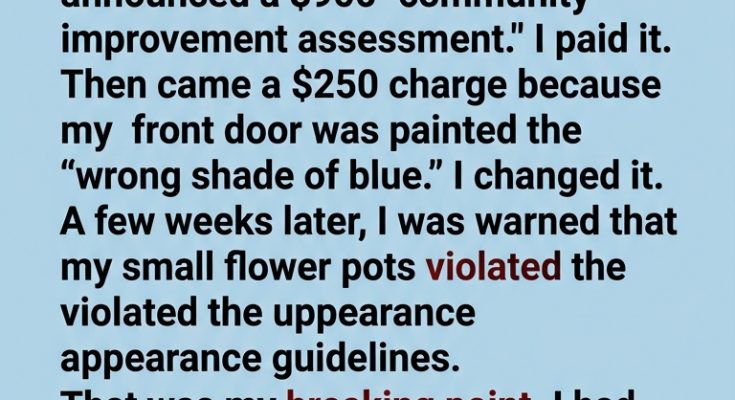
Community Improvement Assessment: $900.
I assumed it was a mistake.
It wasn’t.
The association said the money would be used for landscaping, repainting common areas, and “improving neighborhood appearance.”
I didn’t like it, but I paid.
After all, I had just bought the house. I wasn’t going to start a war over $900.
Then another letter arrived.
This one said my front door was painted the wrong shade of blue.
Apparently, the neighborhood had an approved color palette.
My door was “Blue 7.”
The approved shade was “Blue 9.”
The fine was $250.
I actually laughed when I read it.
Then I realized they were serious.
So I repainted the door.
I figured that would be the end of it.
It wasn’t.
A few weeks later, I received another warning.
My flower pots violated the updated appearance guidelines.
Two tiny flower pots.
Apparently, they were considered “unapproved exterior decorative elements.”
I stared at the letter for several minutes.
Then I looked outside at the pots.
They were sitting quietly beside my own front door.
That’s when something inside me finally snapped.
I called the association.
“Can someone please explain something to me?” I asked. “I own this townhouse. Why does it feel like I need permission to put two flower pots outside my door?”
The woman on the phone sounded polite but rehearsed.
“These guidelines are designed to protect property values.”
“I understand that,” I said. “But where does it end?”
There was a pause.
“All homeowners agree to follow the association’s rules.”
I hung up.
That night, I started reading every document I had received when I bought the house.
And that’s when I discovered something I hadn’t known.
The rules were far more extensive than I realized.
There were restrictions on paint colors, decorations, plants, holiday displays, outdoor furniture, trash cans, window coverings, and even the types of signs homeowners could place near their doors.
But something else caught my attention.
The association board had recently changed several of the appearance guidelines.
And those changes had been approved at a meeting I had never been notified about.
I began digging.
I requested meeting minutes.
I requested financial statements.
I requested copies of the assessment proposal.
And eventually, I discovered something that made my stomach turn.
The $900 assessment wasn’t simply for neighborhood beautification.
A large portion of it was going toward repairing the association’s clubhouse and covering expenses that had accumulated because the association had badly underestimated its previous budget.
In other words, homeowners were being asked to pay for years of poor financial management.
I wasn’t the only one angry.
I started talking to my neighbors.
One woman had been fined $150 for a garden ornament.
Another had received a warning because her curtains were visible from the street.
An elderly couple had been threatened with a fine because their mailbox needed repainting.
Everyone complained privately.
Nobody wanted to challenge the board publicly.
Until I did.
I organized a meeting.
Twenty-three homeowners showed up.
Then thirty-seven.
People brought documents.
Receipts.
Letters.
Warnings.
Fines.
For the first time, everyone realized they weren’t dealing with isolated incidents.
There was a pattern.
We decided to challenge the board at the next association meeting.
I expected shouting.
Instead, something much more powerful happened.
People calmly asked questions.
Where did the assessment money go?
Why had the rules been changed without adequate notice?
Why were homeowners being fined for minor violations while larger maintenance problems remained unresolved?
And most importantly:
Who was actually making these decisions?
The board struggled to answer.
Eventually, several homeowners demanded a new election.
Three weeks later, there was one.
I didn’t run for the board.
I didn’t want the job.
I simply wanted homeowners to have a voice.
The election changed almost the entire board.
The new board reviewed the rules and eliminated several of the most unreasonable restrictions.
The $900 assessment couldn’t simply be erased, but they renegotiated several contracts and found enough savings to reduce future fees.
And my flower pots?
They stayed.
The funny thing is, I never ended up selling the townhouse.
For a while, I seriously considered it.
I thought renting would be easier.
But one morning, I walked outside with a cup of coffee and looked at my front door.
Blue 9.
Two flower pots beside it.
A little garden growing underneath the window.
And I realized something.
The house wasn’t the problem.
The problem was believing that because I owned a home, I had to surrender my voice.
So I stayed.
And I learned something I’ll never forget:
Sometimes fighting for your home doesn’t mean fighting over the walls.
Sometimes it means fighting for the right to feel at home inside them.
And those two little flower pots?
They’re still there.
Every spring, I plant something new.
Not because the association allows it.
Because it’s my home.