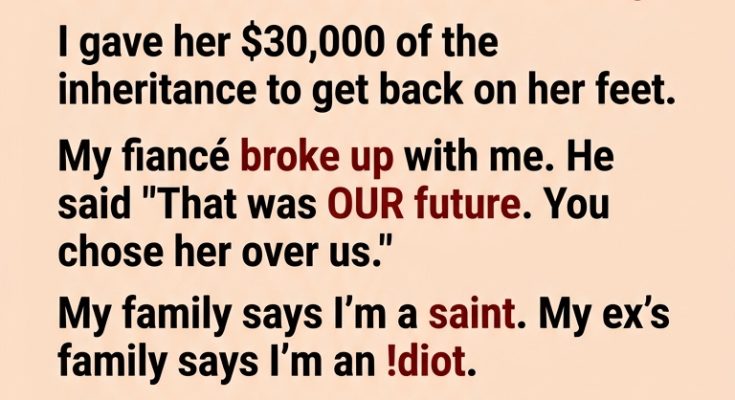
“She Gave Away $30,000—and Lost Her Future”….
My grandma left me $50,000 in her will.
It wasn’t just money.
Before she died, she held my hand and said, “This is for your wedding. I want you to have the beautiful day you always dreamed of.”
I promised her I would.
At the time, I had been engaged to Daniel for almost two years.
We had already picked a venue. We had talked about our honeymoon. We had even started looking at houses.
That $50,000 wasn’t going to pay for everything, but it would give us a head start.
Then, three months before we were supposed to send the final payment to the wedding venue, my cousin Emily’s house burned down.
It happened in the middle of the night.
She escaped with her two children, but almost everything else was gone.
Their clothes.
Furniture.
School supplies.
Family photographs.
The little things that had taken years to collect.
Emily called me crying.
“I don’t know what I’m going to do,” she said. “The insurance company says it’ll take time. We don’t even have enough money for a place to stay.”
I went to see her the next morning.
Her children were sleeping on borrowed mattresses in her mother’s living room.
Emily kept apologizing for crying.
Then she whispered, “I feel like I’ve failed my kids.”
Something inside me broke.
I thought about my grandmother.
I thought about how she had always told me, “Money is useful, sweetheart, but people are priceless.”
That afternoon, I looked at my inheritance account.
There was $50,000.
I transferred $30,000 to Emily.
I didn’t tell Daniel first.
I told myself I’d explain when I got home.
When I finally told him, he stared at me.
“You gave her how much?”
“Thirty thousand.”
He thought I was joking.
I wasn’t.
His face changed.
“That was our wedding money.”
“I know.”
“Our house deposit.”
“I know.”
“Our future.”
“I know, Daniel. But she lost her home. Her children have nothing.”
He was silent for a long time.
Then he said something I’ll never forget.
“That was OUR future. You chose her over us.”
I tried to explain.
“I didn’t choose her over you. I chose to help someone who needed it.”
He shook his head.
“You made a $30,000 decision without me.”
He packed a bag that night.
I thought he’d cool down.
He didn’t.
The next morning, he called off the engagement.
Just like that.
Two years of planning disappeared.
My family was shocked.
But they rallied around me.
My mother hugged me and said, “Your grandma would be proud of you.”
My aunt told everyone, “She sacrificed her wedding to save her cousin’s family.”
People called me a saint.
But Daniel’s family had a very different opinion.
His mother told me, “You threw away your marriage for people who weren’t your responsibility.”
His sister called me an idiot.
Daniel’s father said, “You can’t build a life with someone who doesn’t understand money.”
For weeks, I questioned everything.
I had $20,000 left.
My wedding was canceled.
My fiancé was gone.
And suddenly, everyone had an opinion about what I should have done.
Then one afternoon, Emily came to my apartment.
She brought a small envelope.
“I want you to take this.”
Inside was a handwritten note from her daughter, Lily.
It said:
“Thank you for giving us a home.”
I started crying.
Emily sat beside me.
“I know $30,000 can’t replace everything you lost,” she said. “But you gave my kids something they needed more than furniture.”
“What?”
“Hope.”
Months passed.
Emily eventually received her insurance settlement.
She found a small house to rent and slowly rebuilt her life.
She also started paying me back—not because I demanded it, but because she wanted to.
The first month, she sent me $500.
Then another $500.
She told me, “It might take years, but I’m going to return every dollar.”
I told her she didn’t have to.
She said, “I know. That’s why I will.”
A year later, I was still single.
But something had changed.
I stopped thinking of the $30,000 as money I had lost.
I started thinking of it as money I had used exactly when someone needed it.
One evening, I found the old wedding folder in my closet.
Inside was my grandmother’s original note.
“For your wedding.”
I stared at those words for a long time.
Then I realized something.
Maybe I had misunderstood what she meant.
Maybe Grandma wasn’t telling me what I had to spend the money on.
Maybe she was giving me the freedom to use it in a way that reflected the person she raised me to be.
I never got the wedding she imagined.
I never got the house Daniel and I planned.
But two children who had lost their home got a chance to start again.
And eventually, I learned the hardest lesson of all:
Helping someone doesn’t automatically make you right.
And protecting your own future doesn’t automatically make you selfish.
The real mistake wasn’t giving away the money.
The real mistake was making such a huge financial decision without talking honestly with the person I planned to marry.
Daniel wasn’t completely wrong about that.
Neither was I completely wrong for helping Emily.
We simply discovered, too late, that we had very different ideas about what marriage—and money—were supposed to mean.
Years later, I met someone new.
Before we got serious, I told him the entire story.
I told him about the inheritance.
The $30,000.
The canceled wedding.
The arguments.
Everything.
He listened quietly.
Then he asked me one question.
“If you could go back, would you do it again?”
I thought about Emily’s children sleeping on borrowed mattresses.
I thought about Lily’s little note.
Then I smiled.
“Yes,” I said. “But next time, I’d have the conversation with my partner first.”
He smiled back.
“Good,” he said. “Because if we’re going to build a future together, I want to know what matters to you.”
And that was when I finally understood.
I hadn’t ruined my life.
I had simply lost the wrong person while learning what kind of person I wanted beside me.
My grandmother’s $50,000 didn’t buy me a wedding.
It gave me something much more valuable:
A lesson about love, money, family, boundaries—and the kind of future worth building.