She Saw the Future in Him….
Ms. Rivera noticed Jamal first because he was always last.
Last to turn in his homework.
Last to leave the classroom after the bell.
Last to raise his hand.
And, somehow, always the last to believe that anyone actually cared about him.
Jamal was thirteen years old, but he carried himself like someone much older.
While the other kids talked about video games, weekend plans, and what they wanted to be when they grew up, Jamal worried about grocery money, overdue bills, and whether his little sister had eaten dinner.
His mother had been gone for years, and his father was rarely around. Most evenings, Jamal took care of his seven-year-old sister, Aaliyah.
And when the sun went down, he went to his uncle’s small repair shop and worked until late at night.
That explained why he was always tired.
Why his homework was late.
Why he sometimes fell asleep at his desk.
But Ms. Rivera noticed something else.
Jamal was brilliant.
He could solve complicated problems faster than most students in his class. His essays were thoughtful and unusually mature. Whenever he actually had time to finish an assignment, his work was exceptional.
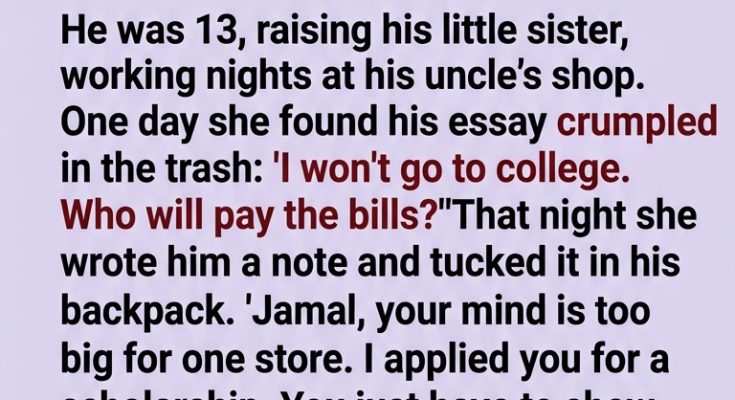
One Friday afternoon, after everyone had left, Ms. Rivera noticed a crumpled piece of paper sticking out of the classroom trash.
She picked it up.
It was Jamal’s college essay.
The assignment had been simple:
“Where do you see yourself in ten years?”
Ms. Rivera carefully unfolded the paper.
The first few lines were hopeful.
Then the tone changed.
“I probably won’t go to college.”
“College costs too much.”
“I have to take care of my sister.”
“Who will pay the bills if I leave?”
At the bottom, Jamal had written one sentence that broke her heart:
“People like me don’t get to dream that far.”
Ms. Rivera sat silently at her desk.
She knew she couldn’t fix Jamal’s entire life.
She couldn’t replace his parents.
She couldn’t erase his responsibilities.
But she could do one thing.
She could make sure he knew someone believed his future was worth fighting for.
That evening, Ms. Rivera stayed late.
She searched scholarship programs.
She contacted counselors.
She filled out forms.
She wrote recommendation letters.
She made phone calls.
And when she found a scholarship program designed for students facing financial hardship, she submitted Jamal’s application.
The next morning, she placed a small handwritten note inside his backpack.
It said:
“Jamal, your mind is too big for one store. I applied for a scholarship for you. You don’t have to have everything figured out. You just have to show up.”
Jamal found the note during lunch.
He read it once.
Then twice.
Then he stared at it for a long time.
When Ms. Rivera walked past his desk, she saw him quickly wipe his eyes.
“Everything okay?” she asked.
He nodded.
Then, almost too quietly to hear, he said:
“Nobody’s ever said something like that to me before.”
From that day forward, something changed.
Jamal still worked at his uncle’s shop.
He still took care of Aaliyah.
Life didn’t suddenly become easy.
But now he had something he hadn’t had before.
A reason to believe his life could become something different.
He began staying after school—not because he was in trouble, but because he wanted extra help.
Ms. Rivera helped him with applications.
The school counselor helped his family find additional support.
His teachers started giving him opportunities instead of excuses.
And Jamal started working harder than anyone expected.
Months later, the scholarship acceptance letter arrived.
Jamal had been awarded enough financial support to continue his education.
He held the letter in his hands and couldn’t speak.
Ms. Rivera smiled.
“See?” she said. “I told you your mind was too big for one store.”
Years passed.
Jamal graduated from high school near the top of his class.
Then came college.
It wasn’t easy.
There were nights he wanted to quit.
There were times he worked part-time jobs just to afford basic expenses.
There were moments when the old voice inside his head whispered:
“People like you don’t make it this far.”
But every time that voice returned, Jamal remembered a crumpled essay.
And a teacher who had refused to throw his future away.
Eventually, graduation day arrived.
The auditorium was packed.
Families filled the seats.
Students waited nervously backstage.
Then Jamal’s name was called.
“Jamal Carter.”
He walked across the stage wearing his graduation gown.
In one hand, he held his diploma.
In the other was the hand of his little sister, Aaliyah, who was now old enough to understand exactly what her brother had sacrificed for her.
The crowd erupted in applause.
Jamal looked out into the audience.
And there she was.
Ms. Rivera.
Standing.
Clapping.
Crying.
Jamal smiled.
Then he looked at Aaliyah.
He squeezed her hand.
And finally, he turned toward Ms. Rivera.
With tears in his eyes, he silently mouthed four words:
“Thank you for seeing me.”
Ms. Rivera placed her hand over her heart.
She didn’t need to say anything.
Because she knew what she had really seen all those years ago.
Not a struggling student.
Not a boy who was always late.
Not a kid who couldn’t afford to dream.
She had seen a young man who simply needed someone to believe in him before he could believe in himself.
And sometimes, that’s all it takes to change a life.
Not money.
Not miracles.
Just one person willing to look at a child and say:
“I see you. And I believe there’s more waiting for you.”
Years later, Jamal became a teacher himself.
And on his first day in his own classroom, he wrote something on the board:
“Your circumstances are not your destiny.”
Underneath it, he added:
“Someone believed in me. Now it’s my turn.”